Q47 · Practice questionComplex familiar5 marks
QUESTION 47 (5 marks)
The idealised conductometric curve shows 25.0 mL of hydrochloric acid titrated with 0.0500 mol L⁻¹ NaOH. Both branches intersect at 20.0 mL.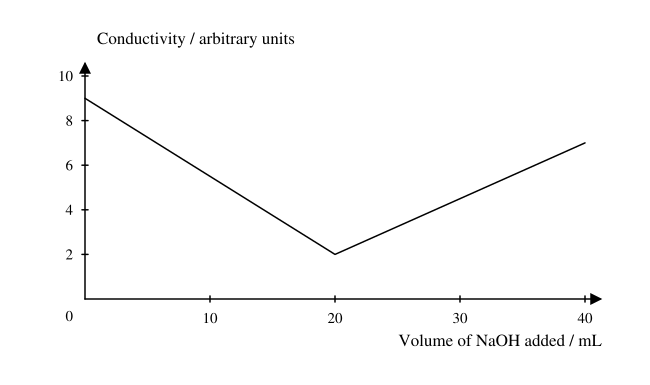
a) Explain why conductivity initially falls. [2 marks]
b) Explain why it rises after the minimum. [1 marks]
c) Calculate the initial HCl concentration. [2 marks]
WORKED SOLUTION
5 marksPractice marking scheme
a) H⁺ is neutralised and replaced by less mobile Na⁺. b) Excess OH⁻ and Na⁺ accumulate. c) 0.0400 mol L⁻¹.
Before equivalence, highly mobile hydrogen ions react with hydroxide to form water, while sodium replaces hydrogen in solution. After equivalence added hydroxide remains in excess. The equivalence moles are 0.0500 × 0.0200 = 0.00100 mol; divide by 0.0250 L.
- Identifies removal of H⁺ by neutralisation. [1 marks]
- Explains replacement by Na⁺ of lower ionic mobility. [1 marks]
- Links post-equivalence rise to excess added ions. [1 marks]
- Calculates equivalence acid moles. [1 marks]
- Calculates 0.0400 mol L⁻¹. [1 marks]
Practice question aligned to the current QCAA syllabus; review the worked solution and marking criteria.
View the QCAA syllabusHow many marks did you earn?
Compare your working with the guide above.