QUESTION 8 (9 marks)
Haloalkanes are useful intermediates for making other organic compounds.
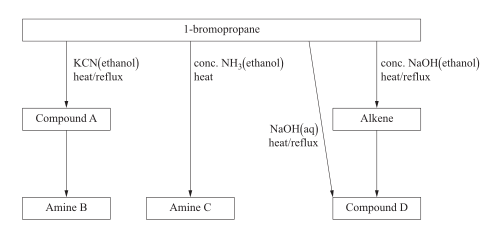
a) Determine the structural formulas and IUPAC names for compounds A and D.
[4 marks]
Note: If you make a mistake, cancel it by ruling a single diagonal line through your work and use the additional response space at the back of this book.
b) Determine the IUPAC name of the alkene formed from 1-bromopropane.
[1 mark]
c) Identify the type of reaction that occurs to convert the alkene to compound D.
[1 mark]
d) Write a balanced chemical equation to show how compound A can form amine B. Include reagents and conditions.
[2 marks]
e) Identify how amine B differs from amine C.
[1 mark]
QCAA guide · typeset solution
QCAA sample response and mark allocation
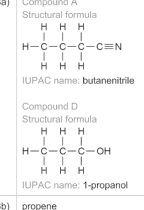
8a) | Compound A Structural formula IUPAC name: butanenitrile Compound D Structural formula IUPAC name: 1-propanol | • determines structural formula for compound A [1 mark] • determines that the IUPAC name for compound A is butanenitrile [1 mark] • determines structural formula for compound D [1 mark] • determines that the IUPAC name for compound D is propanol [1 mark] |
8b) | propene | • determines that the IUPAC name for the alkene is propene [1 mark] |
8c) | addition reaction | • identifies addition reaction [1 mark] |
8d) | heatNi322232222CH CH CH CN2HCH CH CH CH NH+→ | • provides a balanced chemical equation for converting butanenitrile to butanamine [1 mark] • identifies an appropriate catalyst [1 mark] |
8e) | Amine B: butanamine; Amine C: propanamine. Amine B has one extra carbon in its carbon chain. | • identifies that amine B has an extra carbon in its chain [1 mark] |

QCAA sample response and marking criteria reproduced from the official guide.
Compare your working with the guide above.