QUESTION 1 (8 marks)
A galvanic cell was constructed using copper and magnesium electrodes.
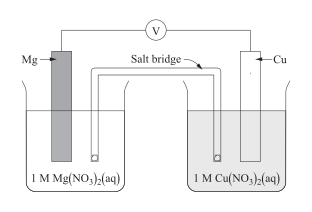
a) Determine the half-equation occurring in the Mg | Mg(NO3)2 half-cell.
[1 mark]
b) Contrast the flow of electrons and the movement of anions in the cell.
[2 marks]
c) Describe two changes that would be observed as the galvanic cell operates.
[2 marks]
d) Predict whether a voltage would be produced if the Mg(s) electrode was replaced with an Al(s) electrode. Explain your reasoning.
[3 marks]
QCAA guide · typeset solution
QCAA sample response and mark allocation
1a) | 2 + − Mg(s) Mg (aq) 2e + ⇌ | • determines the oxidation half-equation for the Mg | Mg(NO3)2 half-cell [1 mark] |
1b) | Electrons flow from the magnesium electrode to the copper electrode via the wire, while anions move through the salt bridge towards the magnesium half-cell. | • identifies that electrons flow from the magnesium electrode to the copper electrode through the wire [1 mark] • identifies that anions move through the salt bridge towards the magnesium half-cell [1 mark] |
1c) | The copper electrode would increase in mass, and the copper nitrate solution would become lighter in colour. | • describes a change observed in the cell [1 mark] • describes a second change observed in the cell [1 mark] |
1d) | A voltage will be produced because Al is a more reactive metal than Cu. Therefore Al will be oxidised and Cu2+ will be reduced. | • predicts that a voltage would be produced [1 mark] • identifies that Al is more reactive than Cu [1 mark] • explains that Al would be oxidised and Cu2+ would be reduced [1 mark] |
QCAA sample response and marking criteria reproduced from the official guide.
Compare your working with the guide above.