QUESTION 28 (8 marks)
A 10.0 mL volume of a weak monoprotic base (BOH) was pipetted into a volumetric flask and diluted to a final volume of 50.0 mL using distilled water. A 25.0 mL aliquot of the BOH solution was then titrated with 0.1 M hydrochloric acid (HCl). The reaction and titration curve are shown.
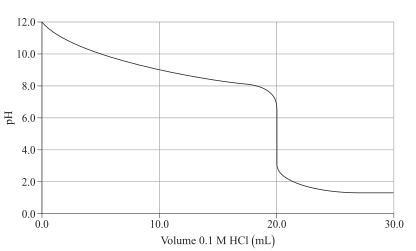
a) Determine the pKb of BOH.
[1 mark]
b) Calculate the concentration of BOH in the original 10.0 mL solution. Show your working.
[3 marks]
c) Determine whether the following features of the titration curve would change if 10.0 mL of 0.2 M sodium hydroxide (NaOH) was titrated with 0.1 M hydrochloric acid (HCl). Explain your reasoning.
[4 marks]
The pH of the equivalence point:
The volume of HCl required to reach the equivalence point:
QCAA guide · typeset solution
QCAA sample response and mark allocation
28a) | pKw = pKa+ pKbpKb= 14 − 9 = 5 | • determines that pKb equals 5 [1 mark] |
28b) | Moles of BOH in 25.0 mL aliquot of diluted base = moles HCl at equivalence point | • determines moles of base in aliquot equals moles of HCl at equivalence point [1 mark] |
• calculates concentration of BOH in aliquot [1 mark] | ||
• calculates concentration of BOH [1 mark] | ||
28c) | The pH of the equivalence point: would increase to pH 7 because NaOH is a strong base. The volume of HCl required to reach the equivalence point: would remain the same, as the moles of base being neutralised has not changed. | • determines that the pH at the equivalence point is 7 [1 mark] • explains that the pH at the equivalence point would increase when a strong base is titrated with a strong acid [1 mark] • determines that the volume of HCl required to reach the equivalence point would not change [1 mark] • explains that the moles of base to be neutralised remains the same [1 mark] |


QCAA sample response and marking criteria reproduced from the official guide.
Compare your working with the guide above.