QUESTION 5 (8 marks)
The diagram shows a galvanic cell with a cell potential of 2.55 V under standard conditions.
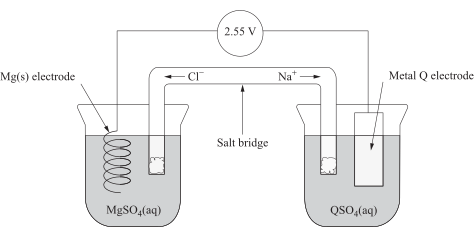
a) Describe the movement of electrons in the galvanic cell.
[3 marks]
b) Determine the half-equation and standard electrode potential for the half-cell that contains metal Q. Include states in your half-equation.
[2 marks]
c) Identify one limitation associated with standard reduction potentials.
[1 mark]
d) Determine whether metal Q is a stronger reducing agent than metallic copper (Cu). Explain your reasoning.
[2 marks]
QCAA guide · typeset solution
QCAA sample response and mark allocation
5a) | Magnesium is the anode and is being oxidised, i.e. it loses electrons. Thus, electrons move from the magnesium electrode through the wire towards metal Q. | • identifies that the magnesium electrode is oxidised [1 mark] • describes the movement of electrons through the wire [1 mark] • identifies that Q2+ ions are reduced [1 mark] |
5b) | Metal Q is reduced. 2Q(aq)2eQ(s)+−+⇌()cellredox2.55Q –2.36EEE=−=−Q2.55 – 2.360.19 V== | • determines the half-equation is 2 + − Q (aq) 2e Q(s) + ⇌ [1 mark] • determines standard electrode potential is +0.19 V [1 mark] |
5c) | All solutions must have a concentration of 1.0 M. | • identifies a limitation [1 mark] |
5d) | 2 + − Q (aq) 2e Q(s) 0.19 V + ⇌ 2 + − C u (aq) 2e Cu (s) 0.3 4 V + ⇌ Q is less positive that Cu, therefore metal Q is a stronger reducing agent than metallic Cu. | • determines metal Q is a stronger reducing agent [1 mark] • explains that the lower the standard reduction potential, the stronger the reducing agent [1 mark] |

QCAA sample response and marking criteria reproduced from the official guide.
Compare your working with the guide above.