QCEVault

Acids, bases and titration — Question 5

QCAA 2023, Paper 2 · 13 marks

Q5 · 2023 · Paper 2Unclassified13 marks

QUESTION 5 (13 marks)

The table gives the properties of four monoprotic acids.

Acid

Concentration (mol L-1)
[H +] (mol L-1)

pH

Ka

1

0.200

7.90 × 10⁻⁵

2

0.100

4.20 × 10⁻³

2.34

1.80 × 10⁻⁴
CH3COOH(aq)

0.100

1.78 × 10⁻⁵

HCl(aq)

0.010

1.00 × 10⁻²

2.00

>1

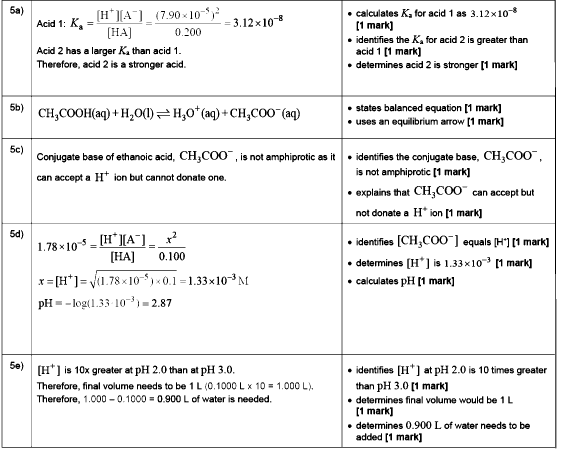
(a) Determine the relative strength of acids 1 and 2 by contrasting their Ka values.

[3 marks]

(b) Write a balanced chemical equation for the dissociation of ethanoic acid (CH3COOH) in water.

[2 marks]

(c) Identify whether the conjugate base of ethanoic acid (CH3COOH(aq)) is amphiprotic. Explain your reasoning.

[2 marks]

(d) Calculate the pH of the aqueous solution of ethanoic acid (CH3COOH). Show your working.

[3 marks]

(e) Determine the volume of water that would need to be added to 100.0 mL of HCl(aq) to change the pH from 2.00 to 3.00. Explain your reasoning.

[3 marks]

Related questions

  1. Q3 · 2025 QCAA · Paper 1 · 1 mark
    QUESTION 3 Identify the amphiprotic species. +(aq) (A) NH4 (B) H3O+(aq) 2−(aq) (C) CO3 −(aq) (D) HCO3
    Acids, bases and titration
  2. Q5 · 2025 QCAA · Paper 1 · 1 mark
    QUESTION 5 A 25.00 mL aliquot of aqueous potassium hydroxide (KOH) solution was titrated against an aqueous solution of 0.100 M hydrochloric acid (HCl). It took 17.45 mL of HCl to reach the equivalence point. Determine the concentration of the KOH(aq) solution. (A) 2.29 × 10⁻¹ M (B) 1.43 × 10⁻¹ M (C) 6.98 × 10⁻² M (D) 4.36 × 10⁻⁵ M
    Acids, bases and titration
  3. Q8 · 2025 QCAA · Paper 1 · 1 mark
    QUESTION 8 Which is the most concentrated weak base? (A) 2.0 M KOH(aq) (B) 0.2 M NaOH(aq) (C) 2.0 M NH4OH(aq) (D) 0.2 M Al(OH)3(aq)
    Acids, bases and titration
  4. Q14 · 2025 QCAA · Paper 1 · 1 mark
    QUESTION 14 Increasing the pH of an aqueous solution of hydrochloric acid (HCl) from 2 to 4 (A) reduces the strength of the acid. (B) increases the acidity of the solution. (C) increases the concentration of H+ ions by a factor of 2. (D) reduces the concentration of H+ ions by a factor of 100.
    Acids, bases and titration