QUESTION 3 (9 marks)
A 50.0 mL solution of ethanoic acid (CH3COOH) was titrated with 15.0 mL of 0.10 M sodium hydroxide (NaOH) solution to reach the equivalence point (pKa ethanoic acid = 4.76).
a) Write a balanced chemical equation to indicate how ethanoic acid acts as a Brønsted-Lowry acid during the titration and identify its conjugate base.
[2 marks]
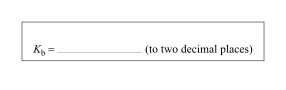
b) Determine the Kb of the conjugate base of ethanoic acid.
[1 mark]
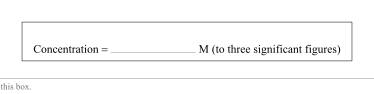
c) Calculate the concentration of the conjugate base at the equivalence point. Show your working.
[2 marks]
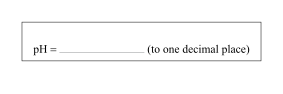
d) Calculate the pH at the equivalence point. Show your working.
[4 marks]
QCAA guide · typeset solution
QCAA sample response and mark allocation
3a) | ( ) ( ) ( ) ( ) − − CH COOH aq OH aq CH COO aq H O I + + ⇌ 3 3 2 The conjugate base formed is CH3COO−. | • provides correct balanced chemical equation [1 mark] • identifies CH3OO− as conjugate base [1 mark] |
3b) | 149.24b4.760151.1.75010001001−−−−×===×K | • determines Kb is 5.75 × 10⁻¹⁰ |
3c) | • determines moles CH3COO− is 1.50 × 10⁻³ [1 mark] • calculates [CH3COO−] is 2.31 × 10⁻² mol L−1 [1 mark] | |
3d) | []3CH COOHOH−==x−−=3b3OHCH COOHCH COOK210b25.75102.31 10−−=×= ×xK2111.3310−=×x63.64OH10−−=×=x()−= −×=6pOHlog 3.64105.445.46pH145..48=−= | • provides correct substitution [1 mark] • calculates [OH−] is 3.64 × 10⁻⁶ M [1 mark] • determines pOH is 5.4 [1 mark] • calculates pH is 8.6 [1 mark] |


QCAA sample response and marking criteria reproduced from the official guide.
Compare your working with the guide above.