QUESTION 24 (7 marks)
This electrochemical cell was constructed using copper and platinum electrodes.
Cu(s) | Cu2+(aq) (1M) || Fe3+(aq) (1M), Fe2+(aq) (1M) | Pt(s)
a) Compare the standard electrode potential (E°) of the two half-cells.
[3 marks]
Similarity:
Difference:
Significance:
b) Write a balanced redox equation for the electrochemical cell.
[1 mark]
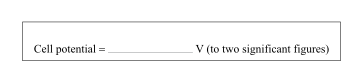
c) Determine the cell potential (in volts) for the electrochemical cell.
[1 mark]
d) Determine the oxidising agent. Explain your reasoning.
[2 marks]
QCAA guide · typeset solution
QCAA sample response and mark allocation
24a) | Similarity: Both the Pt and Cu half-cells have a positive standard reduction potential compared to SHE. Difference: Pt half-cell is more positive than Cu half-cell. Significance: Cu electrode is oxidised (loses electrons) and the Fe3+(aq) is reduced. | • Similarities: identifies that both half-cells have positive standard reduction potential [1 mark] • Differences: identifies that Pt half-cell is more positive than Cu half-cell [1 mark] • Significance: explains that Cu electrode is oxidised and Fe3+ is reduced [1 mark] |
24b) | Balance redox equation: 3 2 2 + + + 2Fe Cu Cu 2Fe + + | • provides correct balanced redox equation [1 mark] |
24c) | • determines cell potential is +0.43 [1 mark] | |
24d) | Fe3+ is the oxidising agent, because ON decreases from +3 to +2. | • identifies Fe3+ as the oxidising agent [1 mark] • indicates oxidation number decreases [1 mark] |
QCAA sample response and marking criteria reproduced from the official guide.
Compare your working with the guide above.