Q28 · 2021 · Paper 1Unclassified3 marks
QUESTION 28 (3 marks)
Sketch the titration curve formed when 20 mL of 0.1 M butylamine (pKa = 10.0) is titrated with 0.1 M hydrochloric acid.
14
13
12
11
10
9
8
7 pH
6
5
4
3
2
1
0 0 2 4 6 8 10 12 14 16 18 20 22 24 26 28
Volume (mL)
Note: If you make a mistake in the sketch cancel it by ruling a single diagonal line through your work
WORKED SOLUTION
3 marksQCAA guide · typeset solution
QCAA sample response and mark allocation
28 | • sketches an S-shaped curve with - the half equivalence point at pH 10 and 10 mL [1 mark] - the equivalence point < pH 7 at 20 mL [1 mark] - initial pH between 10 and 12, and the final pH between 3 and 1 (but not below 1) [1 mark] |
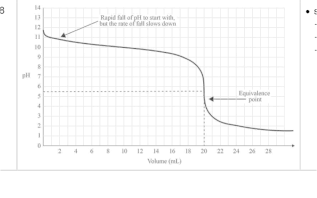
QCAA sample response and marking criteria reproduced from the official guide.
How many marks did you earn?
Compare your working with the guide above.