QUESTION 22 (7 marks)
The structures of phenol red when in either an acidic or a basic solution are shown in the equation.
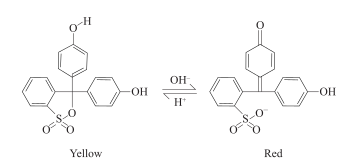
hen in an acidic and a basic solution
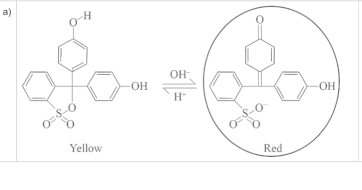
a) Identify the species that acts as the conjugate base by circling it in the equation.
[1 mark]
Note: If you make a mistake, draw a line through this equation and use the additional equation provided on page 13 of this question and response book.
b) A solution of phenol red at equilibrium and 50 °C was found to contain 2.0 × 10⁻⁴ M of the conjugate base and 0.034 M of the acid. Determine the pKa for the system, assuming all the protons present come from dissociation of the acid.
[3 marks]
c) Explain the relationship between the pH range of phenol red and its pKa value.
[3 marks]
QCAA guide · typeset solution
QCAA sample response and mark allocation
22 | a) | • circles the red species [1 mark] |
b) KK | KKa = [2.0 × 10⁻⁴][2.0 × 10⁻⁴]0.034= 1.18 × 10⁻⁶pKKa = –log [1.18 × 10⁻⁶] = 5.9pKKa = 5.9(to two significant figures) | • demonstrates substitution correctlyperformed [1 mark]• determines KKa = 1.2 × 10⁻⁶[1 mark]• determine pKKa = 5.9 [1 mark] | Allow FT error for KKa. Do not penalise for incorrect decimal places/ significant figures. | |
c) | Phenol red changes colour over a pH range because the molecular form (HIn(aq)) and ionic form (ln−(aq)) are different colours. When [HIn(aq)] = [ln−(aq)], the pH = pKKa and phenol red changes colour. When pH < pKKa, the [HIn(aq)] > [ln−(aq)] and phenol red turns yellow. When pH > pKKa, the [HIn(aq)] < [ln−(aq)] and phenol red turns red. | • indicates pH colour range is due to molecular form and ionic form being different colours [1 mark] • identifies phenol red changes colour when pH = pKKa [1 mark] • indicates when pH < pKKa equilbrium favours the molecular form (HIn), the solution is yellow. When pH > pKKa equilbrium favours the ionic form (ln−), the solution is red [1 mark] |


QCAA sample response and marking criteria reproduced from the official guide.
Compare your working with the guide above.