QUESTION 100 (10 marks)
An investigator wants bacteria to make a eukaryotic luminescent protein. Its complete RNA coding region has exons of 150 and 240 nucleotides, including the start codon and one final stop codon, separated in the original gene by a 100-nucleotide intron. The intron contains an early stop and the host cannot splice it. Candidate plasmids have a 1810 bp vector backbone. The digest releases any insert from the backbone; PCR amplifies the whole insert with no additional flanking bases. All exon sequences, insertion orientations and promoters are suitable. Results are shown.
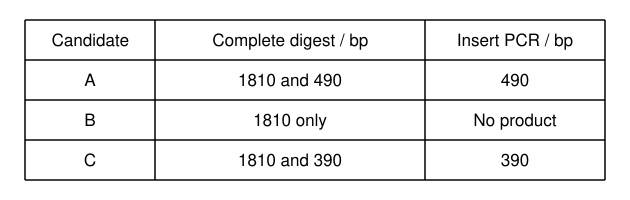
a) Choose the candidate most suitable for producing the intended protein and justify using RNA processing and insert size. [3 marks]
b) Calculate the total DNA length of that plasmid. [1 marks]
c) Starting with one double-stranded target copy, calculate ideal PCR copy number after 10 cycles. [1 marks]
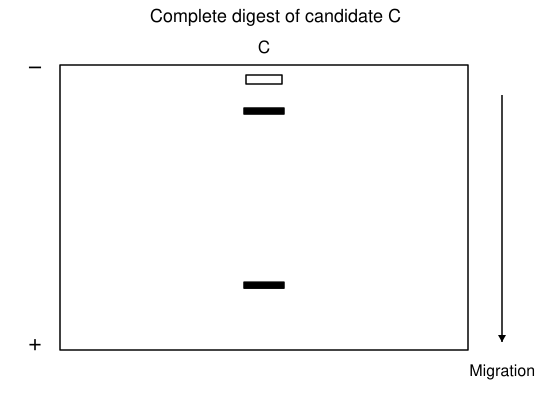
d) State which of the chosen clone’s two digest fragments travels further in a gel. [1 marks]
e) Describe the separate roles of restriction enzymes and DNA ligase in constructing the plasmid. [2 marks]
f) Calculate the number of amino acids in the intended polypeptide. Show your reasoning. [2 marks]
Practice marking scheme
Answer
a) C: its 390 bp insert contains the joined exons without the intron. b) 2200 bp. c) 1024 copies. d) The 390 bp fragment. e) Restriction enzymes cut specific sites; ligase seals the backbone. f) 129 amino acids.
Working
The two exons total bases. Candidate A contains 490 bp, consistent with retaining the 100-base intron; the specified host cannot remove it. B has no insert. C has the required intron-free 390 bp insert. Total C plasmid length is bp. Ideal PCR gives copies. The smaller 390 bp digest fragment migrates further than 1810 bp. Restriction enzymes cut DNA at recognition sites; ligase joins compatible DNA by sealing the sugar-phosphate backbone. The coding RNA has codons, including a stop codon that contributes no amino acid, so the chain contains 129 amino acids.
Marking criteria
- Selects C. [1 mark]
- Determines joined-exon length as 390. [1 mark]
- Explains why an intron-containing insert is unsuitable in the stated host. [1 mark]
- Calculates total plasmid length 2200 bp. [1 mark]
- Calculates PCR copy number 1024. [1 mark]
- Identifies the 390 bp fragment as migrating further. [1 mark]
- Describes specific cutting by restriction enzymes. [1 mark]
- Describes joining/backbone sealing by ligase. [1 mark]
- Calculates 130 codons. [1 mark]
- Subtracts the non-amino-acid stop codon to obtain 129 amino acids. [1 mark]
Practice question aligned to the current QCAA syllabus; review the worked solution and marking criteria.
View the QCAA syllabusCompare your working with the guide above.