Q96 · Practice questionComplex unfamiliar9 marks
QUESTION 96 (9 marks)
Identical starting seed mixtures are placed in wet and dry microhabitats. At the end, plant counts are shown. In species A, gene X has the same DNA sequence in both microhabitats, but dry-site cells have more transcription-factor binding at its promoter and ten times more X mRNA. Use .
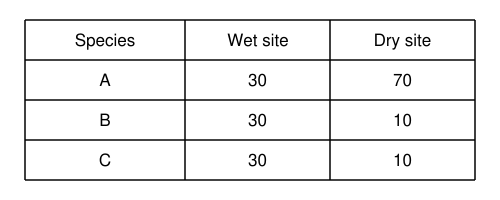
a) Explain how the expression result can occur without a change in gene X’s DNA sequence. [3 marks]
b) Calculate SDI in the wet and dry samples to three decimal places. [3 marks]
c) Compare species richness and evenness in the samples. [2 marks]
d) Explain why the expression difference alone does not demonstrate microevolution in species A. [1 marks]
ANSWER
a) Environmental regulation can alter transcription-factor activity/binding and transcription from the same sequence.
b) Wet 0.674; dry 0.375.
c) Both richness 3; dry is less even.
d) Expression change alone is not evidence of an allele-frequency change.
Transcription factors interact with regulatory/promoter regions and can alter transcription rates in response to environmental signals. More activating-factor binding can yield more mRNA without a mutation. Wet . Dry . Both contain three species, but A dominates the dry sample. The expression difference concerns use of a gene; evidence of microevolution would require a population allele-frequency change.
Links environmental conditions to regulation of transcription-factor activity/binding.
Explains promoter binding affecting transcription rate.
Explains altered expression without altered base sequence.
Uses N = 90 in the finite-sample formula.
Calculates wet SDI 0.674.
Calculates dry SDI 0.375.
States equal richness of three.
Identifies lower evenness in the dry sample.
Distinguishes expression change from population allele-frequency change.