QUESTION 82 (6 marks)
The gel shows DNA profiles at two inherited loci. Each individual has two distinct bands at each locus; one allele at each locus is inherited from each parent. Assume no new mutations and that the child’s mother is M. A, B and C are possible fathers.
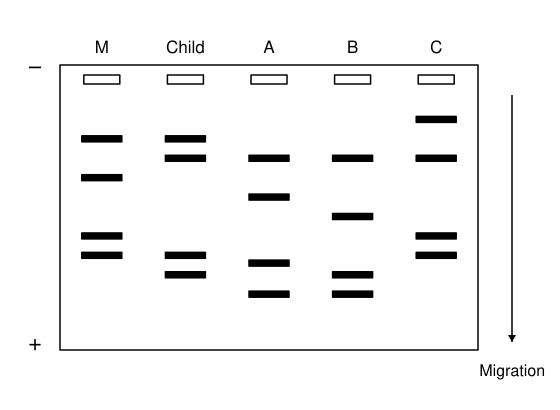
a) Identify the possible father consistent with all the child’s bands. [1 marks]
b) Justify your choice using the child’s bands that are absent from the mother. [2 marks]
c) Explain why the fragments that travel furthest are at the bottom of the gel. [2 marks]
d) Explain why a matching profile at these two loci is not proof that two whole genomes are identical. [1 marks]
Practice marking scheme
Answer
a) B. b) B has both of the child’s non-maternal bands. c) Negatively charged DNA moves towards the positive electrode; smaller fragments pass through the gel more readily. d) Only two loci are tested.
Working
The child’s second-highest and lowest bands are absent from M. Both occur in B, whereas A and C each lack the required lowest band. The remaining child bands occur in M. DNA migrates towards the positive electrode because its backbone is negatively charged; smaller fragments move further through the gel matrix in the same time. Profiles at a small set of loci do not compare every base in the genome.
Marking criteria
- Identifies B. [1 mark]
- Identifies both non-maternal child bands. [1 mark]
- Shows that B contains both and excludes A/C. [1 mark]
- Explains migration of negatively charged DNA to the positive electrode. [1 mark]
- Explains greater migration of smaller fragments. [1 mark]
- Recognises that only a small part of the genome is tested. [1 mark]
Practice question aligned to the current QCAA syllabus; review the worked solution and marking criteria.
View the QCAA syllabusCompare your working with the guide above.