QUESTION 80 (6 marks)
A bacterial plasmid has a replication origin, an antibiotic-resistance marker and one unique restriction site. An investigator wants to insert gene X at that site.
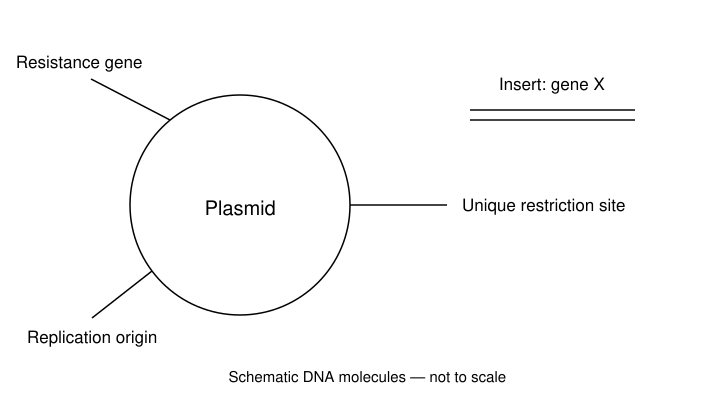
a) Describe the roles of a restriction enzyme and DNA ligase in making recombinant DNA. [2 marks]
b) Explain the benefit of cutting both insert and plasmid with the same suitable restriction enzyme. [2 marks]
c) Colonies grow on the antibiotic after transformation. Explain why this alone does not prove that every colony contains gene X. [2 marks]
Practice marking scheme
Answer
a) The restriction enzyme cuts DNA at its recognition site; ligase seals the joined backbone. b) Corresponding sticky ends can pair, enabling joining. c) A plasmid without the insert may retain resistance.
Working
Restriction enzymes cut specific DNA sequences. Using the same suitable enzyme can generate complementary overhangs on the plasmid and insert; these ends pair before DNA ligase forms covalent backbone bonds. Resistance selection identifies cells able to survive the antibiotic, but an unmodified or self-ligated plasmid can also carry the resistance marker. An insert-specific test is needed to verify gene X.
Marking criteria
- Describes specific DNA cutting by the restriction enzyme. [1 mark]
- Describes backbone joining/sealing by ligase. [1 mark]
- Identifies production of complementary compatible ends. [1 mark]
- Links base pairing of those ends to joining the insert and plasmid. [1 mark]
- Recognises that resistance can be supplied by an empty/self-ligated plasmid. [1 mark]
- Explains the need for an insert-specific check to establish gene X presence. [1 mark]
Practice question aligned to the current QCAA syllabus; review the worked solution and marking criteria.
View the QCAA syllabusCompare your working with the guide above.