QUESTION 79 (6 marks)
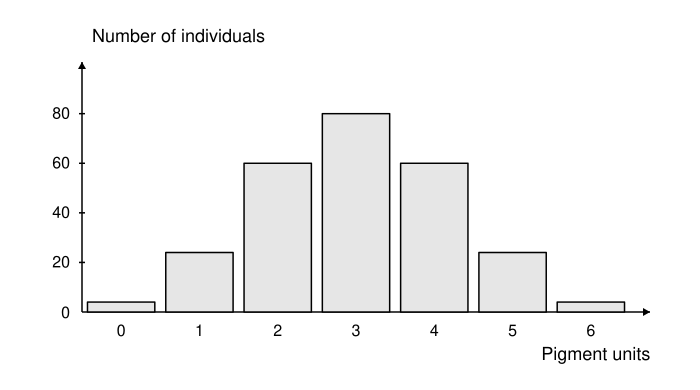
In a hypothetical flower, three independently assorting loci contribute additively to pigment. Each upper-case allele adds one pigment unit. An plant is crossed with an plant. Their offspring are then crossed with one another; the histogram shows 256 offspring of this second cross.
a) Determine the genotype and pigment-unit count of every offspring of the first cross. [2 marks]
b) Identify the most common pigment-unit count in the histogram and explain why intermediate values can be common in polygenic inheritance. [2 marks]
c) Calculate the percentage of the second-cross offspring with six pigment units. [2 marks]
Practice marking scheme
Answer
a) AaBbCc; 3 units. b) 3 units; many allele combinations yield intermediate sums. c) 1.56%.
Working
The first parents produce and gametes, so all first-cross offspring are with three pigment-increasing alleles. In the second cross, several combinations of alleles can produce intermediate totals, whereas the extreme six-unit phenotype requires all six increasing alleles. The histogram records four six-unit offspring out of 256: .
Marking criteria
- States AaBbCc. [1 mark]
- States 3 pigment units. [1 mark]
- Identifies 3 as the modal unit count. [1 mark]
- Explains that multiple allele combinations yield intermediate totals. [1 mark]
- Uses 4/256. [1 mark]
- Calculates approximately 1.56%. [1 mark]
Practice question aligned to the current QCAA syllabus; review the worked solution and marking criteria.
View the QCAA syllabusCompare your working with the guide above.