QUESTION 38 (4 marks)
A biologist uses the key to identify four hypothetical insect species. The specimen has unbranched antennae, spotted wings and no tail filaments.
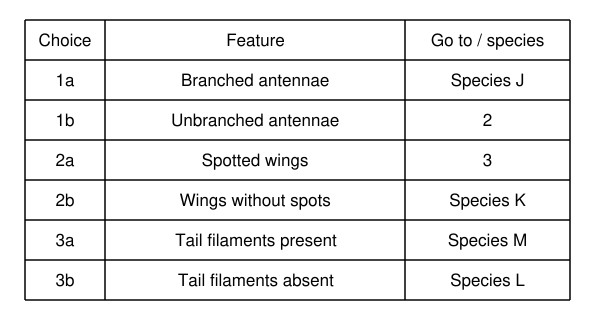
a) Identify the specimen and give the sequence of key choices. [2 marks]
b) Explain why a dichotomous key should use features that are clear and consistently observable. [2 marks]
Practice marking scheme
Answer
a) Species L; 1b → 2a → 3b. b) Ambiguous or variable features can send the same specimen to different endpoints.
Working
Unbranched antennae lead from 1b to step 2. Spotted wings select 2a, then absence of tail filaments selects 3b and species L. Clear observable features reduce misinterpretation and improve repeatability; features such as “looks attractive” depend on subjective judgement.
Marking criteria
- Identifies species L. [1 mark]
- Gives the correct path 1b, 2a, 3b. [1 mark]
- Explains that ambiguous features can cause identification errors. [1 mark]
- Explains that consistent observable features improve repeatability. [1 mark]
Practice question aligned to the current QCAA syllabus; review the worked solution and marking criteria.
View the QCAA syllabusCompare your working with the guide above.