QUESTION 37 (4 marks)
Five quadrats were divided into 25 equal grid cells. The table records the number of cells occupied by a shrub in each quadrat. A cell was counted if at least half its area was covered.
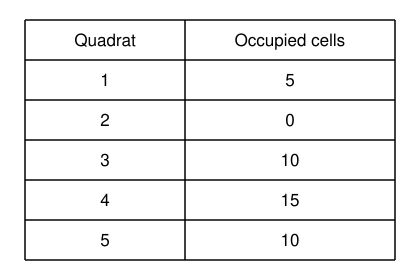
a) Calculate the shrub’s percentage frequency. [1 marks]
b) Calculate mean percentage cover across all five quadrats. [2 marks]
c) Explain why a fixed counting rule improves consistency between observers. [1 marks]
Practice marking scheme
Answer
a) 80%. b) 32%. c) The same threshold reduces observer-dependent decisions.
Working
The shrub occurs in four of the five quadrats, so frequency is . The occupied-cell counts total 40 out of 125 cells, giving mean cover . A consistent inclusion rule prevents different observers from counting partially covered cells differently.
Marking criteria
- Calculates frequency as 80%. [1 mark]
- Uses all five quadrats, including the zero, in the cover calculation. [1 mark]
- Calculates mean cover as 32%. [1 mark]
- Links a fixed threshold to more consistent observer decisions. [1 mark]
Practice question aligned to the current QCAA syllabus; review the worked solution and marking criteria.
View the QCAA syllabusCompare your working with the guide above.