QUESTION 10 (10 marks)
Australian fur seals live in the Southern Ocean and feed on krill. In the 1800s, their population experienced a significant decline due to overharvesting. To monitor their recovery, scientists collected the data shown.
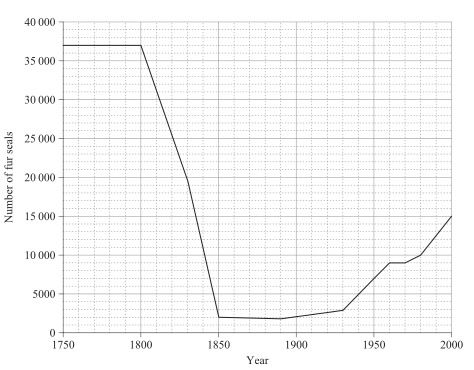
Fur seal population data (1850–2000) | |
Deaths | 1 217 900 |
Immigration | 1500 |
Emigration | 600 |

a) Identify the number of fur seals in 1800.
[1 mark]
b) Determine the number of fur seal births between 1850 and 2000. Show your working.
[2 marks]
c) Infer whether the fur seal population had reached carrying capacity in 2000. Justify your response using evidence from the graph.
[2 marks]
Some researchers believe that the Southern Ocean krill population will decrease by 40% by 2050.
d) Predict how this would affect the carrying capacity of fur seals in the ecosystem. Explain your reasoning.
[2 marks]
M n ×
In 2025, a follow-up study used the capture–recapture technique and the Lincoln index
to N m
estimate the number of fur seals. Results are shown.
Number of fur seals in first capture | 230 |
Number of fur seals in second capture | 250 |
Number of marked fur seals in second capture | 2 |
e) Use the data in the table and the graph on page 12 to determine the average annual population growth rate (%) between 2000 and 2025.
[3 marks]
QCAA guide · typeset solution
QCAA sample response and mark allocation
10a) | 37 000 | • identifies number of seal pups in 1800 [1 mark] |
10b) | • determines population growth [1 mark] | |
• determines the number of births [1 mark] | ||
10c) | The fur seal population hasn’t reached carrying capacity. The number of seal pups has been increasing since ~1890 (except 1960–1970) and shows no signs of plateauing. This suggests the ecosystem has sufficient resources to support a growing population. | • infers the fur seal population has not reached carrying capacity [1 mark] • justifies response using appropriate evidence from the graph [1 mark] |
10d) | As krill are a main food source for fur seals, a 40% decrease in the krill population would mean insufficient food to support the current population, reducing carrying capacity. | • predicts the carrying capacity of fur seals would decrease [1 mark] • explains reasoning [1 mark] |
10e) | • calculates number of seal pups in 2025 [1 mark] | |
• determines growth rate [1 mark] | ||
• determines average annual population growth rate [1 mark] |
QCAA sample response and marking criteria reproduced from the official guide.
Compare your working with the guide above.