QCEVault

Genetics and heredity — Question 3

QCAA 2023, Paper 2 · 7 marks

Q3 · 2023 · Paper 2Unclassified7 marks

QUESTION 3 (7 marks)

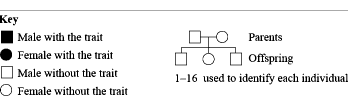
The chart shows the inheritance pattern of a trait, which is thought to be sex-linked dominant.

| nd 1 2

omene 3 4 5 6 7

eeeuenes 8 9 10 11 12 #13 ~ «14
Biology question figure

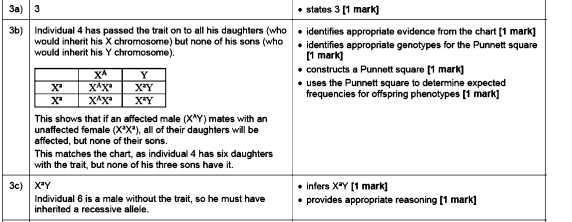
a) Identify how many offspring of individuals 1 and 2 have the trait.

b) Identify evidence to support the conclusion that the trait is sex-linked dominant. Justify your response using a Punnett square. [4 marks]

c) Infer the genotype of individual 6. Explain your reasoning. [2 marks]

Related questions

  1. Q1 · 2025 QCAA · Paper 1 · 1 mark
    QUESTION 1 Which base pairs with adenine during DNA replication? (A) uracil (B) guanine (C) thymine (D) cytosine
    Genetics and heredity
  2. Q4 · 2025 QCAA · Paper 1 · 1 mark
    QUESTION 4 What is the role of tRNA in protein synthesis? (A) acting as a template strand for mRNA (B) matching amino acids to mRNA codons (C) transporting mRNA from the nucleus to the ribosome (D) providing a copy of genetic instructions for the ribosome
    Genetics and heredity
  3. Q5 · 2025 QCAA · Paper 1 · 1 mark
    QUESTION 5 Which option describes the contents of a human cell at metaphase I of meiosis? Number of chromosomes Number of copies of each gene (A) 23 1 (B) 23 2 (C) 46 2 (D) 46 4
    Genetics and heredity
  4. Q10 · 2025 QCAA · Paper 1 · 1 mark
    QUESTION 10 In humans, sex-linked recessive traits are more common in (A) males, because they have a Y chromosome. (B) females, because they have two X chromosomes. (C) males, because they have only one X chromosome. (D) females, because they do not have a Y chromosome.
    Genetics and heredity