QUESTION 23 (5 marks)
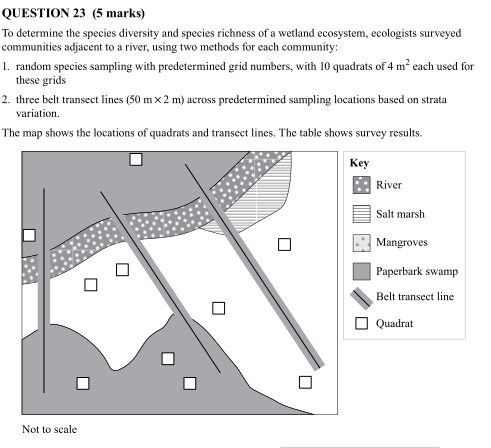
To determine the species diversity and species richness of a wetland ecosystem, ecologists surveyed communities adjacent to a river, using two methods for each community: 1. random species sampling with predetermined grid numbers, with 10 quadrats of 4 m2 each used for
2. three belt transect lines (50 m × 2 m) across predetermined sampling locations based on strata
The map shows the locations of quadrats and transect lines. The table shows survey results.
Survey method | ||
Quadrat | Belt transect | |
Species diversity (Simpson’s diversity index) | 0.6 | 0.8 |
Species richness (number of species) | 16 | 22 |


a) Identify three differences between the survey methods used to determine species diversity and species richness in the ecosystem.
[3 marks]
b) Draw a conclusion about the most suitable method for estimating species diversity and species richness of the communities in this wetland ecosystem. Give a reason to support your conclusion.
[2 marks]
QCAA guide · typeset solution
QCAA sample response and mark allocation
23a) | Quadrats did not cover salt marsh area but transects were placed throughout the different strata. Quadrats sampled a smaller area of 40 m2 compared to a larger area of 300 m2 for transects. Bias was removed in quadrat sampling method by using random sampling, but it wasn’t for transects. | • identifies first difference [1 mark] • identifies second difference [1 mark] • identifies third difference [1 mark] |
23b) | The belt transect was most the most suitable method as it identified more species. | • concludes that the transect method was most suitable [1 mark] • gives a reason [1 mark] |
QCAA sample response and marking criteria reproduced from the official guide.
Compare your working with the guide above.