QCE Vault / Specialist Maths Vector calculus — Question 141 Original QCE Vault practice · 6 marks
Browse all questions Vectors revision Original practice exam Report an issue Q141 · Practice question Technology-active Complex unfamiliar 6 marks
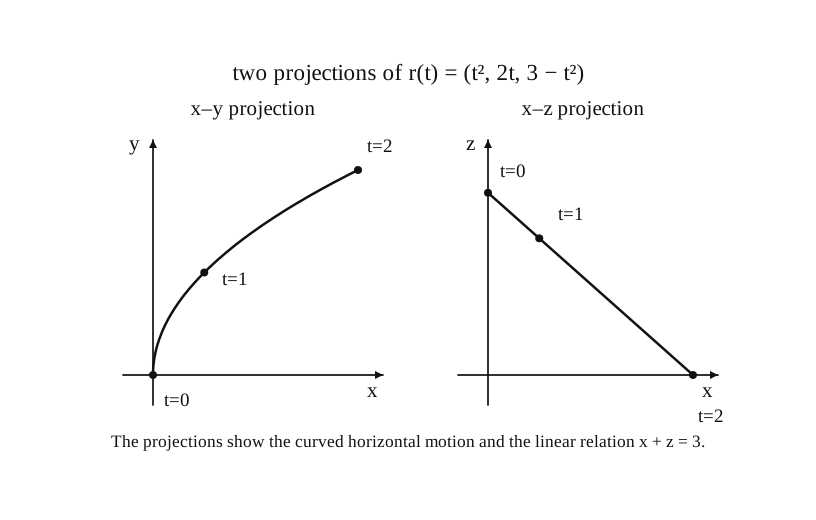
QUESTION 141 (6 marks) A particle has position r ( t ) = ( t 2 , 2 t , 3 − t 2 ) r(t)=(t^{2}, 2t, 3-t^{2}) r ( t ) = ( t 2 , 2 t , 3 − t 2 ) for t ≥ 0 t\ge 0 t ≥ 0 . a) Find velocity and speed at t = 1 t=1 t = 1 . [2 marks] c) Find the time when velocity is perpendicular to acceleration.
[2 marks] ANSWER v ⋅ a = 4 t + 4 t = 8 t v \cdot a=4t+4t=8t v ⋅ a = 4 t + 4 t = 8 t , so perpendicular when t = 0 t=0 t = 0 . Part (a): v = ( 2 t , 2 , − 2 t ) v=(2t,2,-2t) v = ( 2 t , 2 , − 2 t ) ; at t = 1 speed = 4 + 4 + 4 = 2 3 t=1 \text{speed}=\sqrt{4+4+4}=2\sqrt{3} t = 1 speed = 4 + 4 + 4 = 2 3 . Part (b): a = ( 2 , 0 , − 2 ) a=(2,0,-2) a = ( 2 , 0 , − 2 ) . Part (c): v ⋅ a = 4 t + 4 t = 8 t v \cdot a=4t+4t=8t v ⋅ a = 4 t + 4 t = 8 t , so perpendicular when t = 0 t=0 t = 0 . Editorial practice rubric; not an official QCAA marking scheme. Equivalent correct methods are accepted. Method marks may be awarded after an earlier arithmetic error when the subsequent method is valid.
Part (a): Differentiates to v ( t ) = ( 2 t , 2 , − 2 t ) \mathbf v(t)=(2t,2,-2t) v ( t ) = ( 2 t , 2 , − 2 t ) and gives v ( 1 ) = ( 2 , 2 , − 2 ) \mathbf v(1)=(2,2,-2) v ( 1 ) = ( 2 , 2 , − 2 ) . [1 mark] Part (a): Calculates speed ∣ v ( 1 ) ∣ = 2 3 |\mathbf v(1)|=2\sqrt3 ∣ v ( 1 ) ∣ = 2 3 . [1 mark] Part (b): Differentiates velocity component by component, giving ( d ( 2 t ) / d t , d ( 2 ) / d t , d ( − 2 t ) / d t ) (\mathrm{d}(2t)/\mathrm{d}t,\mathrm{d}(2)/\mathrm{d}t,\mathrm{d}(-2t)/\mathrm{d}t) ( d ( 2 t ) / d t , d ( 2 ) / d t , d ( − 2 t ) / d t ) . [1 mark] Part (b): Gives the acceleration vector a = ( 2 , 0 , − 2 ) \mathbf a=(2,0,-2) a = ( 2 , 0 , − 2 ) . [1 mark] Part (c): Uses perpendicularity v ⋅ a = 8 t = 0 \mathbf v\cdot\mathbf a=8t=0 v ⋅ a = 8 t = 0 . [1 mark] Part (c): Obtains the valid time t = 0 t=0 t = 0 . [1 mark] Related questions Q14 · 2024 QCAA · Paper 1 · 5 marks The displacement (cm) of a particle from the origin as it travels in two-dimensional space at time t t t for 0 ≤ t < π 2 0\le t<\frac{\pi}{2} 0 ≤ t < 2 π seconds is given by
r = ( 2 sec ( t ) − 1 ) i ^ + tan ( t ) j ^ . \mathbf r=(2\sec(t)-1)\hat{\mathbf i}+\tan(t)\hat{\mathbf j}. r = ( 2 sec ( t ) − 1 ) i ^ + tan ( t ) j ^ . Vector calculus Q9 · Original practice · 6 marks Original Specialist Mathematics practice question 9: motion in a plane
Vector calculus Q32 · Original practice · 7 marks Two particles move for t ≥ 0 t\ge0 t ≥ 0 with positions r A ( t ) = ( 2 t , t ) , r B ( t ) = ( 6 − t , 4 − 2 t ) . \mathbf r_A(t)=(2t,t),\qquad\mathbf r_B(t)=(6-t,4-2t). r A ( t ) = ( 2 t , t ) , r B ( t ) = ( 6 − t , 4 − 2 t ) . Vector calculus Q34 · Original practice · 6 marks A particle follows the path r ( t ) = ( 3 cos t , 2 sin t ) , 0 ≤ t ≤ 2 π . \mathbf r(t)=(3\cos t,2\sin t),\qquad0\le t\le2\pi. r ( t ) = ( 3 cos t , 2 sin t ) , 0 ≤ t ≤ 2 π . Vector calculus