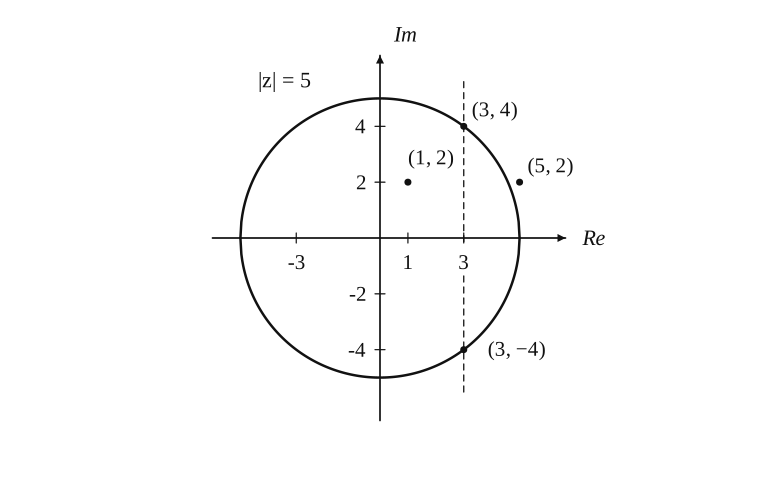
Base between intersections has length 8 and perpendicular distance from origin to x=3 is 3. Area=0.5(8)(3)=12.
Part (a): Equate (x−1)2+(y−2)2=(x−5)2+(y−2)2→x=3.
Part (b): With x=3 and x2+y2=25,y=±4, so z=3±4i.
Part (c): Base between intersections has length 8 and perpendicular distance from origin to x=3 is 3. Area=0.5(8)(3)=12.
Editorial practice rubric; not an official QCAA marking scheme. Equivalent correct methods are accepted. Method marks may be awarded after an earlier arithmetic error when the subsequent method is valid.
Part (a): Forms (x−1)2+(y−2)2=(x−5)2+(y−2)2, or correctly identifies the perpendicular bisector.
[1 mark]
Part (a): Simplifies or justifies the locus x=3.
[1 mark]
Part (b): Combines x=3 with x2+y2=25 to obtain y=±4.
[1 mark]
Part (b): Gives both intersections (3,4),(3,−4), or z=3±4i.
[1 mark]
Part (c): Identifies a base of length 8 and perpendicular height 3, or forms an equivalent determinant.
[1 mark]
Part (c): Calculates the exact area 12 square units.