A plane through p=(1,2,0) containing d1 and d2 has normal d1×d2=(−1,5,3): −(x−1)+5(y−2)+3z=0, or x−5y−3z+9=0.
Worked solution
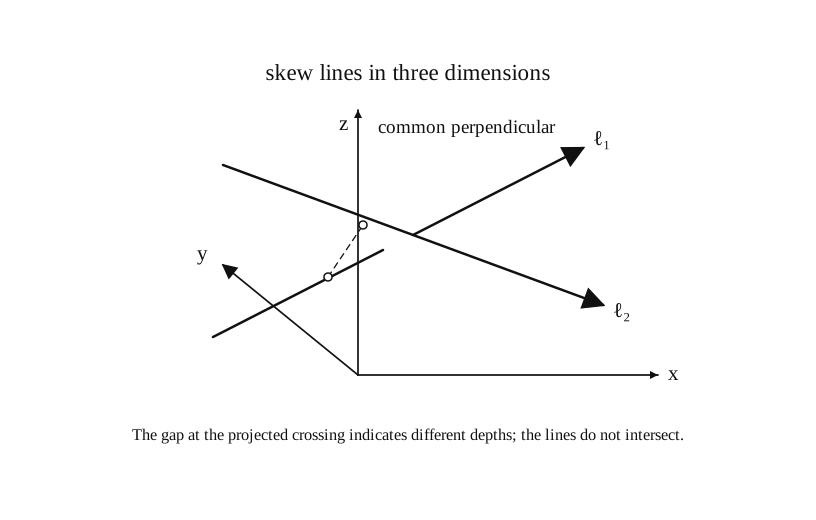
Part (a): Directions are not parallel. Equating coordinates produces inconsistent parameter equations, so the lines do not intersect; hence they are skew.
Part (b): d1×d2=(−1,5,3),q−p=(2,−2,1). Distance=∣d1×d2∣∣(q−p)⋅(d1×d2)∣=35∣−2−10+3∣=359.
Part (c): A plane through p=(1,2,0) containing d1 and d2 has normal d1×d2=(−1,5,3): −(x−1)+5(y−2)+3z=0, or x−5y−3z+9=0.
Part (a): completes the requested reasoning and obtains a correct result.
[2 marks]
Part (b): completes the requested reasoning and obtains a correct result.
[2 marks]
Part (c): completes the requested reasoning and obtains a correct result.
[2 marks]
Practice question aligned to the current QCAA syllabus; review the worked solution and marking criteria.