QCE Vault / Specialist Maths Complex numbers — Question 121 Original QCE Vault practice · 5 marks
Browse all questions Complex numbers revision Original practice exam Report an issue Q121 · Practice question Technology-free Complex familiar 5 marks
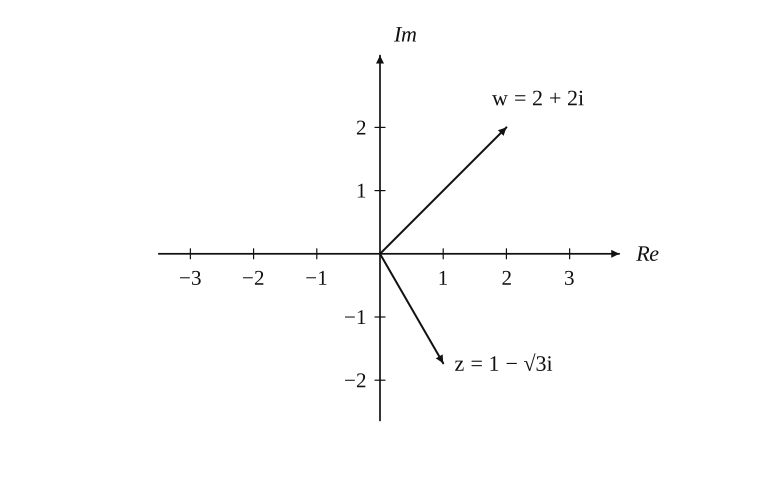
QUESTION 121 (5 marks) Let z = 1 − 3 i z=1-\sqrt{3}i z = 1 − 3 i and w = 2 + 2 i w=2+2i w = 2 + 2 i . a) Express z w \frac{z}{w} w z in modulus-argument form with principal argument. [3 marks] b) Hence find ( z w ) 4 (\frac{z}{w})^{4} ( w z ) 4 in Cartesian form. [2 marks] ANSWER Raise to fourth power: ( 1 4 ) cis ( − 7 π 3 ) = ( 1 4 ) cis ( − π 3 ) = 1 8 − ( 3 8 ) i (\frac{1}{4})\operatorname{cis}(-\frac{7\pi}{3})=(\frac{1}{4})\operatorname{cis}(-\frac{\pi}{3})=\frac{1}{8}-(\frac{\sqrt{3}}{8})i ( 4 1 ) cis ( − 3 7 π ) = ( 4 1 ) cis ( − 3 π ) = 8 1 − ( 8 3 ) i . Part (a): z = 2 cis ( − π 3 ) , w = 2 2 cis ( π 4 ) z=2\operatorname{cis}(-\frac{\pi}{3}), w=2\sqrt{2} \operatorname{cis}(\frac{\pi}{4}) z = 2 cis ( − 3 π ) , w = 2 2 cis ( 4 π ) , so z w = ( 1 2 ) cis ( − 7 π 12 ) \frac{z}{w}=(\frac{1}{\sqrt{2}})\operatorname{cis}(-\frac{7\pi}{12}) w z = ( 2 1 ) cis ( − 12 7 π ) . Part (b): Raise to fourth power: ( 1 4 ) cis ( − 7 π 3 ) = ( 1 4 ) cis ( − π 3 ) = 1 8 − ( 3 8 ) i (\frac{1}{4})\operatorname{cis}(-\frac{7\pi}{3})=(\frac{1}{4})\operatorname{cis}(-\frac{\pi}{3})=\frac{1}{8}-(\frac{\sqrt{3}}{8})i ( 4 1 ) cis ( − 3 7 π ) = ( 4 1 ) cis ( − 3 π ) = 8 1 − ( 8 3 ) i . Editorial practice rubric; not an official QCAA marking scheme. Equivalent correct methods are accepted. Method marks may be awarded after an earlier arithmetic error when the subsequent method is valid.
Part (a): Obtains the quotient modulus 2 / ( 2 2 ) = 1 / 2 2/(2\sqrt2)=1/\sqrt2 2/ ( 2 2 ) = 1/ 2 . [1 mark] Part (a): Finds the arguments of z z z and w w w as − π / 3 -\pi/3 − π /3 and π / 4 \pi/4 π /4 . [1 mark] Part (a): Gives z / w = ( 1 / 2 ) cis ( − 7 π / 12 ) z/w=(1/\sqrt2)\operatorname{cis}(-7\pi/12) z / w = ( 1/ 2 ) cis ( − 7 π /12 ) with principal argument; equivalent Cartesian-to-polar working is accepted. [1 mark] Part (b): Uses de Moivre to obtain modulus 1 / 4 1/4 1/4 and argument − 7 π / 3 -7\pi/3 − 7 π /3 , equivalent to − π / 3 -\pi/3 − π /3 . [1 mark] Part (b): Converts to 1 / 8 − ( 3 / 8 ) i 1/8-(\sqrt3/8)i 1/8 − ( 3 /8 ) i . [1 mark] Related questions Q13 · 2024 QCAA · Paper 1 · 4 marks P ( z ) = a z 2 − i z + 1 − 3 i P(z)=az^2-iz+1-3i P ( z ) = a z 2 − i z + 1 − 3 i and Q ( z ) = z 2 + 3 i z + 2 a Q(z)=z^2+3iz+2a Q ( z ) = z 2 + 3 i z + 2 a , where a ∈ C a\in\mathbb C a ∈ C , have the same remainder when divided by z − i z-i z − i .
Use the remainder theorem to determine the value of a a a . Complex numbers Q13 · 2023 QCAA · Paper 1 · 5 marks Given z ∈ C z\in\mathbb C z ∈ C , where z ≠ 0 z\ne0 z = 0 , prove
∣ ∣ z ∣ z z ˉ ∣ = ∣ z − 1 ∣ . \left|\frac{|z|}{z\bar z}\right|=|z^{-1}|. z z ˉ ∣ z ∣ = ∣ z − 1 ∣. Complex numbers Q18 · 2023 QCAA · Paper 2 · 5 marks Consider the complex solutions to the following equation, where 0 < arg ( z ) < π 0<\arg(z)<\pi 0 < arg ( z ) < π .
( z + 1 ) ( z 14 − z 13 + z 12 − z 11 + ⋯ + z 4 − z 3 + z 2 − z ) = 1 − z . (z+1)(z^{14}-z^{13}+z^{12}-z^{11}+\cdots+z^4-z^3+z^2-z)=1-z. ( z + 1 ) ( z 14 − z 13 + z 12 − z 11 + ⋯ + z 4 − z 3 + z 2 − z ) = 1 − z .
Let w 1 w_1 w 1 be the solution with the maximum possible real part and w 2 w_2 w 2 be the solution with the maximum possible imaginary part.
Show that w 1 4 w 2 ∈ Z \frac{w_1^4}{w_2}\in\mathbb Z w 2 w 1 4 ∈ Z . Complex numbers Q12 · 2022 QCAA · Paper 1 · 6 marks Given z 1 = a + b i z_1=a+bi z 1 = a + bi , z 2 = c + d i z_2=c+di z 2 = c + d i for all a , b , c , d ∈ R a,b,c,d\in\mathbb R a , b , c , d ∈ R and z 2 ≠ 0 z_2\ne0 z 2 = 0 , prove the identity
∣ z 1 z 2 ∣ = ∣ z 1 ∣ ∣ z 2 ∣ . \left|\frac{z_1}{z_2}\right|=\frac{|z_1|}{|z_2|}. z 2 z 1 = ∣ z 2 ∣ ∣ z 1 ∣ . Complex numbers