Vectors in three dimensions — Question 15
QCAA 2020, Paper 1 · 6 marks
Q15 · 2020 · Technology-freeSimple familiar6 marks
QUESTION 15 (6 marks)
The points O (0,0,0), A (−6,2,−2) and C (3,1,2) are represented in three-dimensional space in the diagram. OABC forms a parallelogram in three-dimensional space.
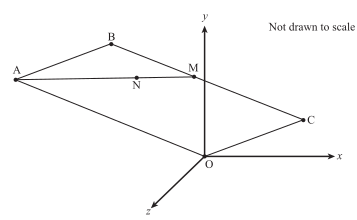
a)Determine the coordinates of B.
b)M is the midpoint of BC. Determine the vector that represents OM. c)N divides AM in the ratio 2:1. Determine the vector that represents ON. d)Use a vector method to show that O, B and N lie on a straight line.
ANSWERB=(−3,3,0), OM=(0,2,1), ON=(−2,2,0) and ON=32OB. a) OB=OA+AC=(−3,3,0), so B=(−3,3,0). b) The midpoint of BC is (0,2,1), so OM=(0,2,1). c) ON=31OA+32OM=(−2,2,0). d) ON=32(−3,3,0)=32OB. The vectors are parallel with common point O, so O, B and N are collinear. correctly determines the coordinates of B
determines vector OM determines an expression for ON involving OA and the 1:2 ratio determines vector ON correctly communicates a requirement that O, B and N lie on a straight line
correctly demonstrates that the requirement has been met
QCAA marking guide
Related questions
- Q12 · 2025 QCAA · Paper 1 · 6 marks
A line, l, is given by the equation
−2x+1=2y−3=z−2. - Q14 · 2023 QCAA · Paper 1 · 6 marks
Consider a cube with three edges positioned along the x-, y- and z-axes on the Cartesian plane as shown. Points O, A and B are vertices of the cube. - Q11 · 2021 QCAA · Paper 2 · 4 marks
OABC is a triangular-based pyramid, as shown. The vertices are A(1,2,5), B(−1,2,−2) and C(0,5,2). Use a vector method to determine the area of the shaded face ABC. - Q3 · Original practice · 1 mark
Original Specialist Mathematics practice question 3: line and plane