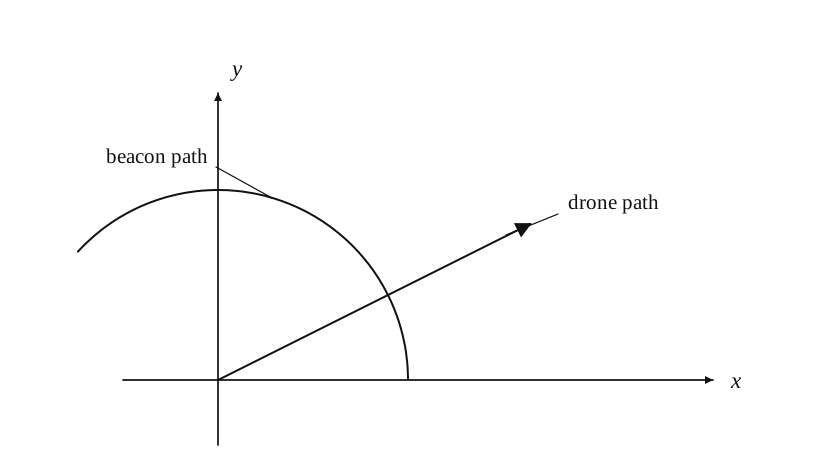
(a) The separation vector is s=(2t−8cos0.4t,t−8sin0.4t). Thus D(t)=∣s∣2=(2t−8cos0.4t)2+(t−8sin0.4t)2.
(b) Numerically minimise D(t) on [0,6], including comparison with both endpoints. The minimum occurs at t≈2.138h, with dmin=D(t)≈4.019km.
(c) Differentiating both positions gives vD=(2,1),vB=(−3.2sin0.4t,3.2cos0.4t). Therefore vD−vB=(2+3.2sin0.4t,1−3.2cos0.4t). Evaluating at the unrounded minimising time gives approximately (4.415,−1.099), with magnitude 4.550kmh−1.
Forms the separation vector and squared separation.
[2 marks]
Numerically determines the minimising time.
[2 marks]
Determines minimum separation.
[1 mark]
Forms the relative velocity.
[1 mark]
Determines its magnitude.
[1 mark]
Practice question aligned to the current QCAA syllabus; review the worked solution and marking criteria.