Q164 · Practice questionTechnology-freeComplex familiar5 marks
QUESTION 164 (5 marks)
A monic polynomial of degree four has real coefficients. Two of its zeros are represented by and on the Argand plane:
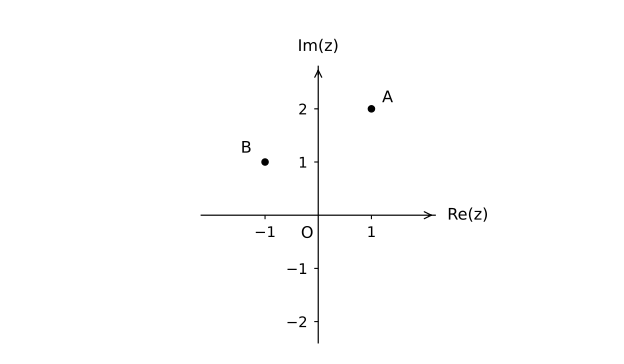
a)[2 marks]
State the other two zeros and justify why they must occur.
b)[3 marks]
Determine in expanded form.
ANSWER
(a) The other zeros are and .
(b) .
(a) By the complex conjugate root theorem, and are zeros. These four zeros are distinct, so they account for the full degree.
(b) Pair conjugate factors:
Since the polynomial is monic,
The cubic terms cancel. The constant term is , which independently checks the expansion.
Equivalent mathematically justified methods accepted.
Exact answers unless a decimal accuracy is specified.
Part a: State both conjugate zeros.
Part a: Use the conjugate root theorem for real coefficients.
Part b: Form the two real quadratic factors.
Part b: Use monicity and multiply the factors.
Part b: Obtain z to the fourth plus 3z squared plus 6z plus 10.