Q16 · 2025 · Technology-freeComplex familiar5 marks
QUESTION 16 (5 marks)
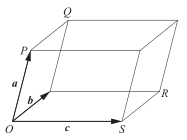
A parallelepiped is a three-dimensional figure where all six faces are parallelograms. It can be defined by vectors a, b and c, as shown. The origin O and points P, Q, R and S are vertices of the parallelepiped.
Use vectors a, b and c to prove that the diagonal from P to R and the diagonal from Q to S bisect each other.
The diagonals PR and QS have the same midpoint 21(a+b+c).
The diagonal vectors are
PR=b+c−a,QS=c−a−b.
The position vector of the midpoint of PR is
a+21PR=21(a+b+c).
The position vector of the midpoint of QS is
a+b+21QS=21(a+b+c).
The midpoint position vectors coincide, so the diagonals PR and QS bisect each other.
correctly represents PR in terms of a, b and c
[1 mark]
correctly represents QS in terms of a, b and c
[1 mark]
determines a vector representing the midpoint of PR
[1 mark]
determines a vector representing the midpoint of QS in terms of a, b and c
[1 mark]
completes the proof with appropriate justification