Gravity and motion — Question 136
Original QCE Vault practice · 8 marks
Q136 · Practice questionComplex unfamiliar8 marks
QUESTION 136 (8 marks)
A moon of radius 1.74×10⁶m and mass 7.35×10²²kg has a research satellite in a circular orbit 100km above its surface. 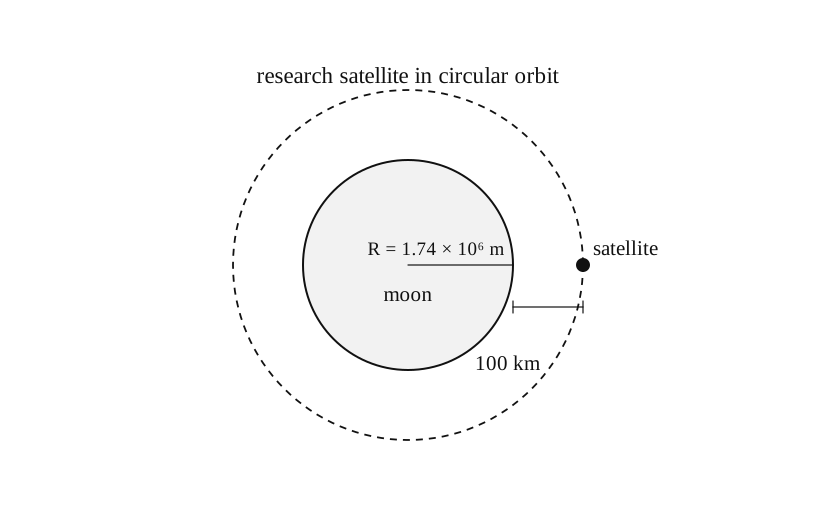
a)Calculate the gravitational field strength at the satellite.
b)Calculate the orbital speed.
c)Calculate the orbital period.
d)Determine the specific mechanical energy (energy per unit satellite mass) of the circular orbit.
WORKED SOLUTION
Practice marking scheme
8 marksANSWERFor a circular orbit, epsilon=−2rGM=−2(1.84×10⁶)6.674×10⁻¹¹)(7.35×1022=−1.33×10⁶Jkg−1. Worked solution
Part (a): r=1.84×10⁶m. g=r2GM=(1.84×10⁶)26.674×10⁻¹¹)(7.35×1022=1.45ms−2. Part (b): v=rGM=1.63×10³ms−1. Part (c): T=v2πr=7.09×10³s=1.97h. Part (d): For a circular orbit, epsilon=−2rGM=−2(1.84×10⁶)6.674×10⁻¹¹)(7.35×1022=−1.33×10⁶Jkg−1. Part (a): completes the requested reasoning and obtains a correct result.
Part (b): completes the requested reasoning and obtains a correct result.
Part (c): completes the requested reasoning and obtains a correct result.
Part (d): completes the requested reasoning and obtains a correct result.
Practice question aligned to the current QCAA syllabus; review the worked solution and marking criteria.
View the QCAA syllabusHow many marks did you earn?Compare your working with the guide above.