QCE Vault / Physics Projectile motion — Question 102 Original QCE Vault practice · 1 mark
Browse all questions Projectile motion revision Original practice exam Report an issue Q102 · Practice question Complex familiar 1 mark
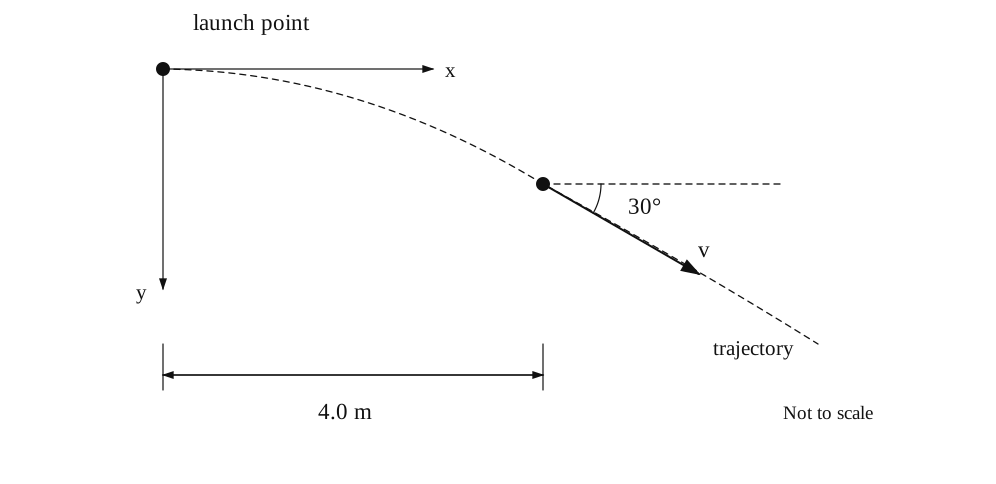
QUESTION 102 A ball is launched horizontally. Air resistance is negligible. When the ball has travelled a horizontal distance of 4.0 m 4.0\,\mathrm{m} 4.0 m , its velocity is directed 30 ∘ 30^\circ 3 0 ∘ below the horizontal. Take g = 9.8 m s − 2 g=9.8\,\mathrm{m\,s^{-2}} g = 9.8 m s − 2 . What was the ball's initial speed? (A) 4.76 m s − 1 4.76\,\mathrm{m\,s^{-1}} 4.76 m s − 1 (B) 6.26 m s − 1 6.26\,\mathrm{m\,s^{-1}} 6.26 m s − 1 (C) 8.24 m s − 1 8.24\,\mathrm{m\,s^{-1}} 8.24 m s − 1 (D) 11.7 m s − 1 11.7\,\mathrm{m\,s^{-1}} 11.7 m s − 1 Answer: C — 8.24 m s − 1 8.24\text{ m s}^{-1} 8.24 m s − 1 . For a horizontal launch, the horizontal speed is constant:
At the marked point,
tan 30 ∘ = v y v x = g t u .
\tan 30^\circ=\frac{v_y}{v_x}=\frac{gt}{u}.
tan 3 0 ∘ = v x v y = u g t . The horizontal displacement is
4.0 = u t ⇒ t = 4.0 u .
4.0=ut \quad\Rightarrow\quad t=\frac{4.0}{u}.
4.0 = u t ⇒ t = u 4.0 . Therefore
tan 30 ∘ = g ( 4.0 / u ) u = 4.0 g u 2 ,
\tan30^\circ=\frac{g(4.0/u)}{u}=\frac{4.0g}{u^2},
tan 3 0 ∘ = u g ( 4.0/ u ) = u 2 4.0 g , so
u = 4.0 ( 9.8 ) tan 30 ∘ = 8.24 m s − 1 .
u=\sqrt{\frac{4.0(9.8)}{\tan30^\circ}}=8.24\text{ m s}^{-1}.
u = tan 3 0 ∘ 4.0 ( 9.8 ) = 8.24 m s − 1 . Key insight: the direction of the instantaneous velocity gives the ratio of the vertical and horizontal velocity components.