Q142 · Practice questionComplex familiar1 mark
QUESTION 142
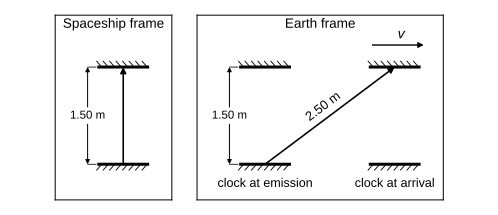
A spaceship carries a light clock: a light pulse travels between two mirrors that are 1.50 m apart, measured perpendicular to the direction of motion of the spaceship. The mirrors are 1.50 m apart for observers on the spaceship and for observers on Earth.
The diagram shows the path of one pulse from the bottom mirror to the top mirror, as described by each set of observers. In the Earth frame, the path travelled by the pulse is 2.50 m long.
What is the speed of the spaceship relative to Earth?
(A)
(B)
(C)
(D)
WORKED SOLUTION
1 markAnswer D
ANSWER
D
Worked solution
Answer: (D) .
Key insight. The light-clock diagram is a right-angled triangle in disguise: the vertical leg is (the proper time), the hypotenuse is (the Earth-frame time), and the horizontal leg is . The ratio hypotenuse : vertical leg is the time-dilation factor .
Reasoning. In the Earth frame the pulse travels 2.50 m at speed , so the flight lasts . During that time the clock moves horizontally
so .
Check using the data book formula: , and gives .
Why the other options are wrong.
- **(A) ** — : uses the vertical leg instead of the horizontal leg; this is , not .
- **(B) ** — this is : confusing with .
- **(C) ** — : divides the vertical leg by the horizontal leg, ignoring that the pulse travels at along the hypotenuse.
Marking. 1 mark for (D). All four values are distinct; each wrong option reproduces a specific, identifiable error (verified numerically).
Selects option D.
Practice question aligned to the current QCAA syllabus; review the worked solution and marking criteria.
View the QCAA syllabus