Q141 · Practice questionComplex unfamiliar9 marks
QUESTION 141 (9 marks)
A ball is kicked from level ground and lands on the flat roof of a building. Air resistance is negligible.
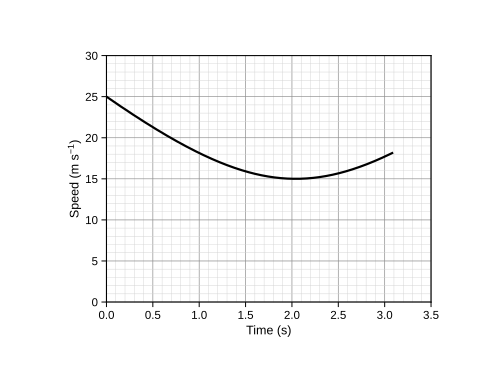
The graph shows the speed of the ball from the instant it is kicked until the instant it lands on the roof.
a)[2 marks]
Explain why the speed of the ball never falls to zero.
b)[2 marks]
Determine the angle above the horizontal at which the ball was kicked.
c)[3 marks]
Determine the height of the roof above the ground. Show your working.
d)[2 marks]
A second ball is kicked from the same point with the same initial speed, but at above the horizontal. It also lands on the roof.
Determine the speed of the second ball when it lands.
WORKED SOLUTION
9 marksPractice marking scheme
ANSWER
(a) Horizontal velocity remains non-zero. (b) . (c) . (d) .
Worked solution
Key insight. A speed–time graph of a projectile is not two straight lines: its minimum value is the horizontal component of the velocity, and the landing speed depends only on the launch speed and the height gained — not on the launch angle.
Part a · 2 marks
There is no horizontal force, so the horizontal component of velocity is constant. At the highest point the vertical component is zero, but the horizontal component is not, so the speed there is equal to the (non-zero) horizontal component.
recognises that the horizontal component of velocity is constant (no horizontal force/acceleration)
identifies that at the highest point only the horizontal component remains (vertical component is zero), so speed is not zero
Part b · 2 marks
From the graph: initial speed ; minimum speed (at , the highest point).
Tolerance: –. Alternative: from the time of the minimum, then .
identifies the initial speed as and the minimum speed as
calculates the angle
Part c · 3 marks
From the graph the ball lands at with speed .
Method 1 (components). . At landing , so
(moving down, since the ball has passed its highest point).
Method 2 (time). .
Tolerance: – (reading the end of the curve to gives –; reading to gives –). Allow FT from b).
recognises the appropriate relationship for vertical motion (or )
determines the required quantities from the graph and the earlier part (final speed or time; or )
calculates the height
Part d · 2 marks
, . (This ball rises to , above the roof, and lands on the way down.)
The same landing speed as the first ball. Because , the landing speed depends only on the launch speed and the height of the roof.
Tolerance: ; if the roof height from c) is – then – is acceptable (FT).
calculates the vertical component of velocity at the roof using the roof height
combines components to calculate the speed
Practice question aligned to the current QCAA syllabus; review the worked solution and marking criteria.
View the QCAA syllabusHow many marks did you earn?
Compare your working with the guide above.