Q178 · Practice questionComplex unfamiliar6 marks
QUESTION 178 (6 marks)
A train moves right at relative to the ground. At ground time , its rear and front are at and , respectively. Light pulses are emitted inward from both ends simultaneously in the ground frame. An observer at the train's centre is then at and keeps moving with the train. Use .
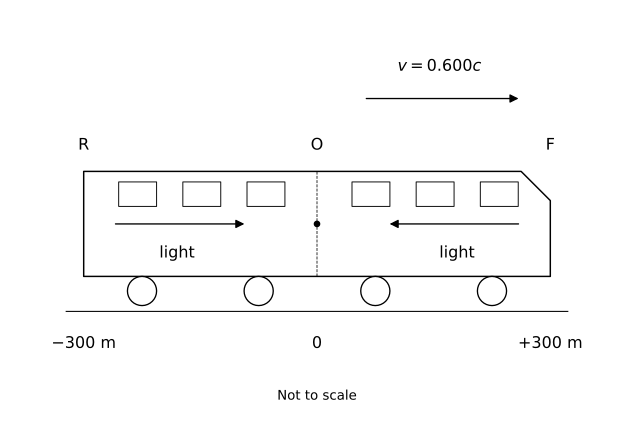
a)[3 marks]
Calculate the ground-frame time at which each pulse reaches the train-centre observer.
b)[3 marks]
Explain whether the emission events are simultaneous in the train frame, and which occurs first in that frame.
ANSWER
(a) Front pulse: ; rear pulse: .
(b) They are not simultaneous; the front emission occurs first.
(a) The observer is at . The front pulse is at , so . The rear pulse is at , so . These are closing-speed calculations within the ground frame; each light pulse still travels at speed .
(b) In the train frame the observer remains midway between stationary train ends, so the pulses travel equal distances at speed . The observer receives the front pulse first, and the ordering of two arrival events at the same observer is shared by both frames. Equal transit times then require the front emission to have occurred earlier in the train frame.
Equivalent physically justified methods and consistent equivalent units accepted.
Displayed decimals are model answers; accept appropriate significant figures and consistent rounding from stated constants.
Part a: Use moving-observer and pulse positions consistently in the ground frame.
Part a: Calculate the front arrival time.
Part a: Calculate the rear arrival time.
Part b: Use equal end-to-centre distances and equal light speeds in the train frame.
Part b: Connect earlier front reception with earlier front emission in that frame.
Part b: Conclude that ground-frame simultaneity is not train-frame simultaneity.