Q159 · Practice questionComplex unfamiliar6 marks
QUESTION 159 (6 marks)
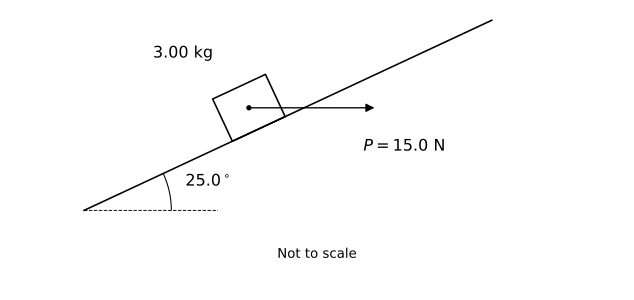
A block is moving up a incline. A horizontal force of pushes it to the right. Friction of acts down the slope. Use .
a)[3 marks]
Determine the normal force.
b)[3 marks]
Determine the acceleration and explain whether the block speeds up or slows down at this instant.
ANSWER
(a) .
(b) downhill; it slows down.
(a) The horizontal push has a component into the plane. With no perpendicular acceleration, .
(b) Taking uphill positive, . Thus . Its velocity is uphill and acceleration downhill, so its speed decreases.
Equivalent physically justified methods and consistent equivalent units accepted.
Displayed decimals are model answers; accept appropriate significant figures and consistent rounding from stated constants.
Part a: Resolve weight perpendicular to the plane.
Part a: Recognise that the push increases the normal force by its perpendicular component.
Part a: Calculate the normal force.
Part b: Resolve the push parallel to the incline.
Part b: Calculate the signed acceleration including friction and weight.
Part b: Relate opposite velocity and acceleration directions to decreasing speed.