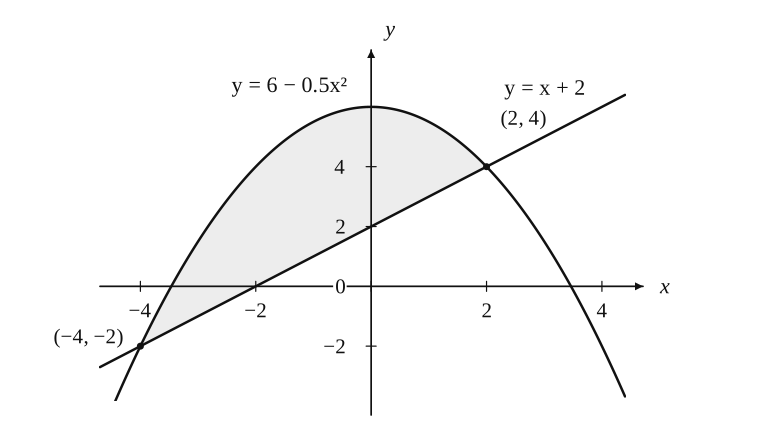
The parabola is above the line between the intersections, so Area=∫−42[(6−0.5x2)−(x+2)]dx=∫−42(4−x−0.5x2)dx=[4x−2x2−6x3]−42=18 square units.
Part (a): Solve 6−0.5x2=x+2, giving x2+2x−8=0 and x=−4,2. The corresponding intersection points are (−4,−2) and (2,4).
Part (b): The parabola is above the line between the intersections, so Area=∫−42[(6−0.5x2)−(x+2)]dx=∫−42(4−x−0.5x2)dx=[4x−2x2−6x3]−42=18 square units.
Editorial practice rubric; not an official QCAA marking scheme. Equivalent correct methods are accepted. Method marks may be awarded after an earlier arithmetic error when the subsequent method is valid.
Part (a): Equates the curves and solves x2+2x−8=0 to obtain x=−4,2.
[1 mark]
Part (a): Gives both intersection points (−4,−2) and (2,4).
[1 mark]
Part (b): Sets up ∫−42[(6−0.5x2)−(x+2)]dx with upper curve minus lower curve.
[1 mark]
Part (b): Obtains the antiderivative 4x−2x2−6x3, or equivalent.
[1 mark]
Part (b): Evaluates the limits to obtain 18 square units; an equivalent correct split-area method is accepted.