QCEVault

Discrete random variables — Question 10

QCAA 2025, Paper 1 · 1 mark

Q10 · 2025 · Technology-freeSimple familiar1 mark

QUESTION 10

Researchers asked 100 customers at a cafe about their daily coffee consumption. The results are shown.
Determine the probability that a randomly selected customer from this group drinks more than three coffees a day.
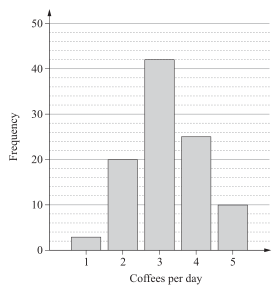
Bar chart of daily coffee consumption for 100 cafe customers
(A)
77100\frac{77}{100}
(B)
2150\frac{21}{50}
(C)
720\frac7{20}
(D)
14\frac14
Question linkOriginal paper

Related questions

  1. Q17 · 2025 QCAA · Paper 1 · 6 marks
    In a computer fishing game, a player repeatedly casts their hook into either a blue pond or a red pond. Each fish they catch scores points. In the blue pond, the probability of catching a fish on a cast is 23\frac23 and each fish caught scores 10 points. In the red pond, the probability of catching a fish on a cast is 13\frac13 and each fish caught scores 15…
    Discrete random variables
  2. Q8 · 2025 QCAA · Paper 2 · 1 mark
    The table shows the probability distribution for a random variable XX in a Bernoulli experiment. The random variable has only two possible values: 0 represents failure and 1 represents success.
    xx01
    P(X=x)P(X=x)0.60.4
    If six Bernoulli experiments are conducted, determine the probability of getting exactly two successes.
    Discrete random variables
  3. Q15 · 2025 QCAA · Paper 2 · 3 marks
    A tour operator offers day cruises off the Queensland coast. They advertise that on any given day, customers have a 65% probability of seeing at least one whale. The tour operator conducts cruises for 40 consecutive days. Let XX be the binomial random variable representing the outcome — success or failure — over the 40 days. A success is customers seeing at…
    Discrete random variables
  4. Q12 · 2024 QCAA · Paper 1 · 6 marks
    Each day over a three-day long weekend, a family spins a pointer on a circular board to decide whether they will spend the day at the beach or bushwalking. The circular board consists of three equal sections.
    Discrete random variables