Q19 · 2022 · Technology-activeComplex unfamiliar4 marks
QUESTION 19 (4 marks)
Flying foxes enter and leave a fruit-growing region every evening. The rate at which the flying foxes enter the region is modelled by The rate at which the flying foxes leave the region is modelled by Both and are measured in animals per minute and is measured in minutes after 7 pm. There are 100 flying foxes in the region at 7 pm. Determine the maximum number of flying foxes in the region and the time that this occurs.
WORKED SOLUTION
4 marksQCAA guide · typeset solution
ANSWER
Maximum of 7034 flying foxes at 9:58 pm.
Worked solution
Integrating the entry and exit rates and using gives Using a GDC to sketch identifies the maximum point Therefore the maximum is 7034 flying foxes, occurring about 177.729 minutes after 7 pm, i.e. at 9:58 pm.
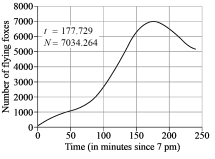
correctly determines the function to model the total number of flying foxes in the region
uses an appropriate mathematical method to identify the maximum values
determines the maximum number of flying foxes and time, i.e. the coordinates of the turning point
states the number of flying foxes as a whole number and the time after 7 pm it occurs
One QCAA sample method typeset for web; criterion wording is adapted from the official marking guide.
View the full QCAA marking guideHow many marks did you earn?
Compare your working with the guide above.