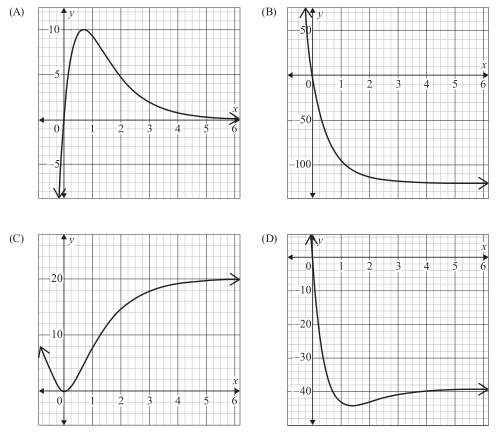
Q5 · 2020 · Technology-activeSimple familiar1 markQUESTION 5An object moves in a straight line with a velocity vvv given by v(t)=40(e−t−e−2t) m s−1,t≥0.v(t)=40(e^{-t}-e^{-2t})\;\mathrm{m\,s^{-1}},\quad t\ge0.v(t)=40(e−t−e−2t)ms−1,t≥0. The object is at the origin initially. The displacement–time graph in the first 6 seconds isABCDCheck answerReveal worked solutionQuestion linkOriginal paperANSWERCs(t)=∫40(e−t−e−2t)dt=20−40e−t+20e−2t=20(1−e−t)2s(t)=\int40(e^{-t}-e^{-2t})dt=20-40e^{-t}+20e^{-2t}=20(1-e^{-t})^2s(t)=∫40(e−t−e−2t)dt=20−40e−t+20e−2t=20(1−e−t)2 using s(0)=0s(0)=0s(0)=0. It starts at 0, increases and approaches 20, so C.Selects option C.[1 mark]QCAA marking guide