QCE Vault / Mathematical Methods Further applications of differentiation — Question 13 QCAA 2020, Paper 1 · 7 marks
Browse all questions Differentiation revision Original practice exam Report an issue Q13 · 2020 · Technology-free Simple familiar 7 marks
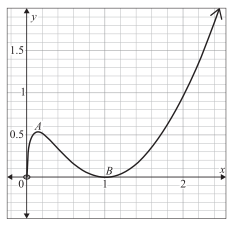
QUESTION 13 (7 marks) A function is defined as f ( x ) = x ( ln ( x ) ) 2 f(x)=x(\ln(x))^2 f ( x ) = x ( ln ( x ) ) 2 , x > 0 x>0 x > 0 . The graph of the function is shown and has a local maximum at point A and a global minimum at point B. The derivative of the function is given by f ′ ( x ) = 2 ln ( x ) + ( ln ( x ) ) 2 f'(x)=2\ln(x)+(\ln(x))^2 f ′ ( x ) = 2 ln ( x ) + ( ln ( x ) ) 2 , x > 0 x>0 x > 0 . a) Verify that there is a stationary point at x = 1 x=1 x = 1 . [2 marks] b) Determine the coordinates of A.
[3 marks] c) The graph of the function has a point of inflection at x = e p x=e^p x = e p . Determine p p p . [2 marks] ANSWER a) stationary at x = 1 x=1 x = 1 ; b) A ( e − 2 , 4 e − 2 ) A(e^{-2},4e^{-2}) A ( e − 2 , 4 e − 2 ) ; a) Set f ′ ( x ) = 0 f'(x)=0 f ′ ( x ) = 0 : 0 = 2 ln x + ( ln x ) 2 = ln x ( 2 + ln x ) . 0=2\ln x+(\ln x)^2=\ln x(2+\ln x). 0 = 2 ln x + ( ln x ) 2 = ln x ( 2 + ln x ) . One solution is ln x = 0 \ln x=0 ln x = 0 , hence x = 1 x=1 x = 1 . b) The other stationary point satisfies 2 + ln x = 0 2+\ln x=0 2 + ln x = 0 , so x = e − 2 x=e^{-2} x = e − 2 . Then y = e − 2 ( ln e − 2 ) 2 = 4 e − 2 y=e^{-2}(\ln e^{-2})^2=4e^{-2} y = e − 2 ( ln e − 2 ) 2 = 4 e − 2 . Thus A ( e − 2 , 4 e − 2 ) A(e^{-2},4e^{-2}) A ( e − 2 , 4 e − 2 ) . c) f ′ ′ ( x ) = 2 x + 2 ln x x = 2 x ( 1 + ln x ) . f''(x)=\frac{2}{x}+\frac{2\ln x}{x}=\frac{2}{x}(1+\ln x). f ′′ ( x ) = x 2 + x 2 ln x = x 2 ( 1 + ln x ) . Setting f ′ ′ ( x ) = 0 f''(x)=0 f ′′ ( x ) = 0 gives x = e − 1 x=e^{-1} x = e − 1 , so p = − 1 p=-1 p = − 1 . correctly identifies that the derivative equals 0
[1 mark] correctly shows there is a stationary point at x = 1 x=1 x = 1 [1 mark] correctly establishes the equation in x x x [1 mark] correctly determines the x x x -ordinate of A [1 mark] determines y y y -ordinate of A [1 mark] correctly establishes the equation in x x x equals 0 [1 mark] QCAA marking guide
Related questions Q13 · 2025 QCAA · Paper 1 · 4 marks Use f ′ ′ ( x ) = 2 x − 6 f''(x)=2x-6 f ′′ ( x ) = 2 x − 6 to demonstrate that the function y = f ( x ) y=f(x) y = f ( x ) has a point of inflection at x = 3 x=3 x = 3 . Further applications of differentiation Q19 · 2025 QCAA · Paper 1 · 5 marks A farmer wishes to construct the shortest possible fence to enclose a triangular area in the corner of a paddock. There are two existing fences, the western fence and the southern fence.
The new fence must pass through the old homestead gate, as shown.
Determine the length of the shortest possible fence.
Verifying that the fence length is a minimum is not r…
Further applications of differentiation Q9 · 2025 QCAA · Paper 2 · 1 mark Determine the gradient of the line perpendicular to the tangent to the graph of y = ln ( 4 x ) y=\ln(4x) y = ln ( 4 x ) at the point ( 0.8 , 1.163 ) (0.8,1.163) ( 0.8 , 1.163 ) . Further applications of differentiation Q10 · 2025 QCAA · Paper 2 · 1 mark The outside air temperature, T T T (°C), on a particular day at a certain location is modelled by the function T = 25 − 7 cos ( π t 12 ) , 0 ≤ t ≤ 24 , T=25-7\cos\left(\frac{\pi t}{12}\right),\qquad0\le t\le24, T = 25 − 7 cos ( 12 π t ) , 0 ≤ t ≤ 24 , where t t t is the time (hours) since 6:00 am.
The rate of change of temperature at 11:30 am is Further applications of differentiation