Continuous random variables and the normal distribution — Question 329
Original QCE Vault practice · 7 marks
Q329 · Practice questionTechnology-freeComplex unfamiliar7 marks
QUESTION 329 (7 marks)
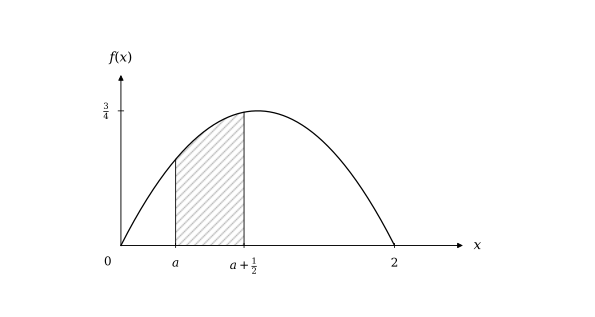
A visitor's arrival time X hours has density f(x)=43x(2−x) for 0≤x≤2, and zero otherwise. An organiser chooses a half-hour prize window [a,a+1/2], where 0≤a≤3/2.
a)
Write the probability P(a) of arrival during the prize window as a definite integral.
[1 mark]
b)
Determine the value of a that maximises P(a), with justification.
b) An antiderivative is G(x)=43(x2−x3/3). Thus P(a)=G(a+1/2)−G(a) and P′(a)=f(a+1/2)−f(a)=9/16−3a/4. The derivative is positive before a=3/4 and negative after it, establishing the global maximum.
c) G(5/4)−G(3/4)=47/128.
Exact answers unless rounding is specified; equivalent forms accepted.
a) Gives the correct definite integral.
[1 mark]
b) Expresses the probability using an antiderivative.