QCE Vault / Mathematical Methods Continuous random variables and the normal distribution — Question 328 Original QCE Vault practice · 7 marks
Browse all questions Continuous probability and normal distributions revision Original practice exam Report an issue Q328 · Practice question Technology-free Complex unfamiliar 7 marks
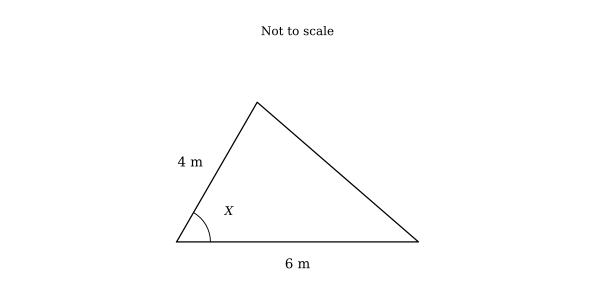
QUESTION 328 (7 marks) A hinged triangular shade has sides of lengths 4 4 4 m and 6 6 6 m meeting at a random angle X X X radians. Its angle density is f ( x ) = 1 2 sin x f(x)=\dfrac12\sin x f ( x ) = 2 1 sin x for 0 ≤ x ≤ π 0\leq x\leq\pi 0 ≤ x ≤ π , and zero otherwise. a) Verify that f f f is a valid density. [2 marks] b) Determine the exact probability that the shade area is at least 6 3 m 2 6\sqrt3\ \mathrm{m}^2 6 3 m 2 . [3 marks] c) Six independent shades use this angle model. Determine the probability that at least four meet the area requirement.
[2 marks] ANSWER a) Nonnegative with integral 1.
a) sin x ≥ 0 \sin x\geq0 sin x ≥ 0 on [ 0 , π ] [0,\pi] [ 0 , π ] , and ∫ 0 π 1 2 sin x d x = [ − 1 2 cos x ] 0 π = 1 \int_0^\pi\frac12\sin x\,dx=[-\frac12\cos x]_0^\pi=1 ∫ 0 π 2 1 sin x d x = [ − 2 1 cos x ] 0 π = 1 . b) Area is 12 sin X 12\sin X 12 sin X . The requirement is sin X ≥ 3 / 2 \sin X\geq\sqrt3/2 sin X ≥ 3 /2 , or π / 3 ≤ X ≤ 2 π / 3 \pi/3\leq X\leq2\pi/3 π /3 ≤ X ≤ 2 π /3 . Integrate the density between these bounds to obtain 1 / 2 1/2 1/2 . c) The qualifying count is Y ∼ Bin ( 6 , 1 / 2 ) Y\sim\operatorname{Bin}(6,1/2) Y ∼ Bin ( 6 , 1/2 ) . The upper tail is ( 15 + 6 + 1 ) / 64 = 11 / 32 (15+6+1)/64=11/32 ( 15 + 6 + 1 ) /64 = 11/32 . Exact answers unless rounding is specified; equivalent forms accepted.
b) Forms the area inequality.
[1 mark] b) Determines the angle interval.
[1 mark] b) Integrates to obtain 1/2.
[1 mark] c) Uses a binomial model.
[1 mark] c) Gives the exact upper tail.
[1 mark] Related questions Q17 · 2025 QCAA · Paper 2 · 4 marks The probability density function approximates the time (s) that people spend viewing a particular photo on a social media page.
p ( t ) = { k e − 7 t / 50 , 0 ≤ t ≤ 20 , 0 , otherwise. p(t)=\begin{cases}ke^{-7t/50},&0\le t\le20,\\0,&\text{otherwise.}\end{cases} p ( t ) = { k e − 7 t /50 , 0 , 0 ≤ t ≤ 20 , otherwise.
Determine the mean time people spend viewing the photo. Continuous random variables and the normal distribution Q19 · 2025 QCAA · Paper 2 · 6 marks A scientist is gathering data on two species of horned beetle, species A and B. Horn length is a method of distinguishing the species.
Species A horn lengths are normally distributed with a mean of 20 mm and a standard deviation of 2 mm.
It is known that 14.6% of species B beetles have horns shorter than 18 mm.
In the particular population the scientist is s…
Continuous random variables and the normal distribution Q2 · 2024 QCAA · Paper 2 · 1 mark Calculate the expected value of a continuous random variable X X X with the probability density function p ( x ) = { 1 4 x 2 , 0 ≤ x ≤ 12 3 0 , otherwise . p(x)=\begin{cases}\frac14x^2,&0\le x\le\sqrt[3]{12}\\0,&\text{otherwise}.\end{cases} p ( x ) = { 4 1 x 2 , 0 , 0 ≤ x ≤ 3 12 otherwise . Continuous random variables and the normal distribution Q5 · 2024 QCAA · Paper 2 · 1 mark The mass (g) of adult kookaburras in a certain region is normally distributed with a mean of 300 g and a standard deviation of 13 g. Select the correct statement about the mass of adult kookaburras.
Continuous random variables and the normal distribution