QCEVault

Differentiation of trigonometric functions and differentiation rules — Question 275

Original QCE Vault practice · 5 marks

Q275 · Practice questionTechnology-freeComplex familiar5 marks

QUESTION 275 (5 marks)

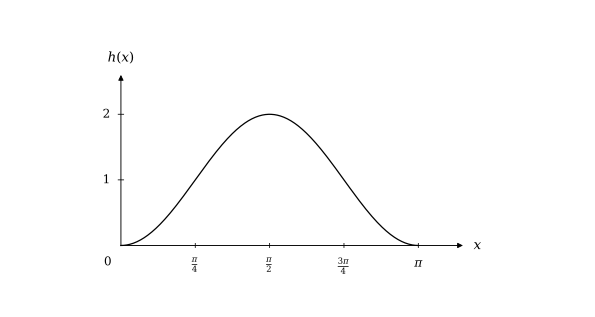
The height of a decorative wave is modelled by h(x)=2sin⁡2xh(x)=2\sin^2x for 0≤x≤π0\leq x\leq\pi.
Graph of h(x)=2 sin squared(x), from x=0 to pi, with maximum height 2 and zeros at both ends.
a)
Show that h′(x)=4sin⁡xcos⁡xh^{\prime}(x)=4\sin x\cos x.
[1 mark]
b)
Determine the interior stationary point and classify it.
[2 marks]
c)
Determine the exact intervals on which the graph is concave up.
[2 marks]
Question link

Related questions

  1. Q6 · 2024 QCAA · Paper 2 · 1 mark
    Determine the derivative of y=2xcos⁡(3x)y=2x\cos(3x).
    Differentiation of trigonometric functions and differentiation rules
  2. Q1 · 2023 QCAA · Paper 2 · 1 mark
    For f(x)=sin⁡(3x)f(x)=\sin(3x), f′(π8)f'(\frac\pi8) is closest to
    Differentiation of trigonometric functions and differentiation rules
  3. Q1 · 2022 QCAA · Paper 2 · 1 mark
    The position (in cm) of a particle is given by x=cos⁡(4t)x=\cos(4t), where tt is time (in seconds). The velocity of the particle when t=5t=5 is
    Differentiation of trigonometric functions and differentiation rules
  4. Q8 · 2021 QCAA · Paper 2 · 1 mark
    The displacement (in metres) of a particle is given by s(t)=−3cos⁡(t)+2sin⁡(t)s(t)=-3\cos(t)+2\sin(t), where tt is in seconds. The instantaneous velocity of the particle at time t=π2t=\dfrac\pi2 seconds is
    Differentiation of trigonometric functions and differentiation rules