QCEVault

Differentiation of exponential and logarithmic functions — Question 270

Original QCE Vault practice · 4 marks

Q270 · Practice questionTechnology-freeSimple familiar4 marks

QUESTION 270 (4 marks)

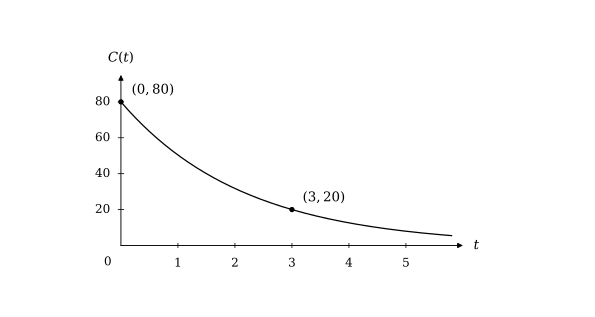
The scent concentration from a diffuser is modelled by C(t)=Ae−ktC(t)=Ae^{-kt}, where CC is measured in arbitrary units and tt in hours. Measurements give C(0)=80C(0)=80 and C(3)=20C(3)=20.
Decreasing exponential concentration curve through the labelled points (0,80) and (3,20).
a)
Determine AA and the exact value of kk.
[2 marks]
b)
Determine when the concentration first falls to 1010 units.
[2 marks]
Question link

Related questions

  1. Q7 · 2025 QCAA · Paper 1 · 1 mark
    Determine ddxe4x+3\dfrac{d}{dx}e^{4x+3}.
    Differentiation of exponential and logarithmic functions
  2. Q4 · 2025 QCAA · Paper 2 · 1 mark
    An object moves in a straight line such that its velocity (m s−1^{-1}) is given by v(t)=t2−e−tv(t)=t^2-e^{-t} for 0≤t≤50\le t\le5, where tt represents time (s). Determine the time, tt, when the acceleration of the object is 22 m s−2^{-2}.
    Differentiation of exponential and logarithmic functions
  3. Q2 · 2024 QCAA · Paper 1 · 1 mark
    If y=esin⁡xy=e^{\sin x}, then dydx\frac{dy}{dx} is
    Differentiation of exponential and logarithmic functions
  4. Q6 · 2024 QCAA · Paper 1 · 1 mark
    Differentiate y=ln⁡(x)cos⁡(x)y=\ln(x)\cos(x) with respect to xx.
    Differentiation of exponential and logarithmic functions