QUESTION 99 (9 marks)
The matrix gives pairwise differences in one conserved DNA sequence. D is an outgroup. Assume fewer differences indicate closer relatedness. For A and B, use the molecular-clock model , with differences per million years in each lineage. For this question only, assume sequence divergence tracks population divergence exactly. A geographic barrier between A and B formed 1 million years ago.
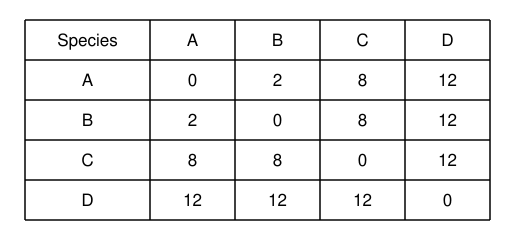
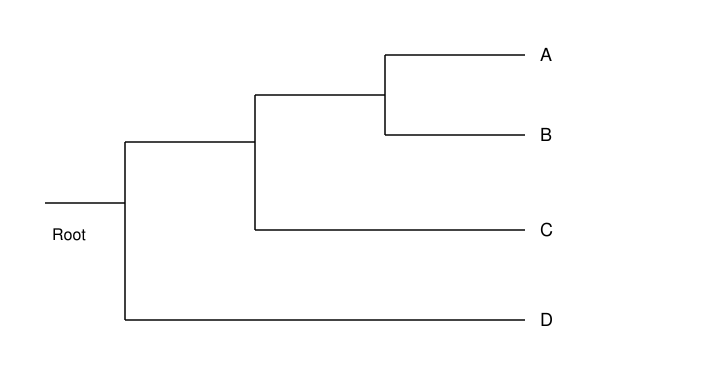
a) Draw a rooted cladogram consistent with the matrix. [2 marks]
b) Estimate the A–B divergence time. [2 marks]
c) Determine whether the recent barrier alone can account for the full inferred separation history under the stated model. Justify numerically. [2 marks]
d) Explain how a geographic barrier can promote allopatric speciation. [3 marks]
Practice marking scheme
Answer
a) (((A,B),C),D). b) 4 million years. c) No: modelled divergence precedes the 1-million-year-old barrier by 3 million years. d) Reduced gene flow permits divergence and eventual reproductive isolation.
Working
A and B differ at only two sites; C is closer to that pair than D. The clock gives million years. Under the explicit model assumption, this predates the stated barrier, so an earlier separation/history is needed; in real studies, rate uncertainty and ancestral variation would also require consideration. A geographic barrier can reduce interbreeding and gene flow, allowing mutation, selection and drift to produce divergence that eventually causes reproductive isolation.
Marking criteria
- Draws A and B as a sister pair joined to C. [1 mark]
- Places D as outgroup. [1 mark]
- Uses t = d/(2r). [1 mark]
- Calculates 4 million years. [1 mark]
- Rejects the barrier as the sole explanation under the model. [1 mark]
- Uses the 4-versus-1-million-year comparison. [1 mark]
- Explains reduced interbreeding/gene flow. [1 mark]
- Explains independent genetic divergence. [1 mark]
- Links divergence to reproductive isolation/allopatric speciation. [1 mark]
Practice question aligned to the current QCAA syllabus; review the worked solution and marking criteria.
View the QCAA syllabusCompare your working with the guide above.