QUESTION 97 (9 marks)
A diploid beetle population is exposed to an insecticide. Survival data are shown. After exposure, 12 aa adults immigrate. No further births or deaths occur before the next count.
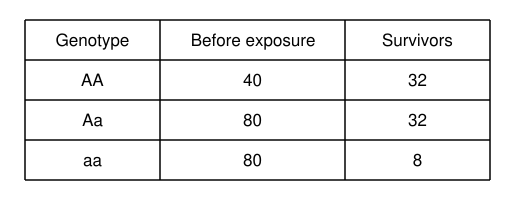
a) Calculate the survival percentage for each genotype. [2 marks]
b) Calculate A frequency before and after exposure. [3 marks]
c) Calculate A frequency after immigration. [2 marks]
d) Distinguish the process responsible for the exposure change from the process responsible for the immigration change. [2 marks]
Practice marking scheme
Answer
a) AA 80%; Aa 40%; aa 10%. b) 0.40 before; 0.667 after. c) 0.571. d) Differential genotype survival is selection; breeding immigration introduces alleles by gene flow.
Working
Survival is , and . Before exposure, . Survivors number 72, with 96 A copies: . The 12 aa immigrants add no A copies but add 24 total alleles, giving . The first change reflects unequal survival under a selection pressure; the later local gene-pool change is due to gene flow, assuming the immigrants join the breeding population.
Marking criteria
- Calculates AA survival as 80%. [1 mark]
- Calculates Aa and aa survival as 40% and 10%. [1 mark]
- Uses diploid allele denominators rather than genotype counts. [1 mark]
- Calculates initial A frequency 0.40. [1 mark]
- Calculates survivor A frequency 0.667. [1 mark]
- Adds 24 total alleles and no A copies. [1 mark]
- Calculates post-immigration frequency 0.571. [1 mark]
- Identifies natural selection through differential survival. [1 mark]
- Identifies gene flow through immigration into the breeding population. [1 mark]
Practice question aligned to the current QCAA syllabus; review the worked solution and marking criteria.
View the QCAA syllabusCompare your working with the guide above.