QUESTION 90 (6 marks)
The table shows an aligned 12-base conserved sequence from four hypothetical species. D is the outgroup. Assume fewer differences in this sequence indicate closer relatedness for this question.
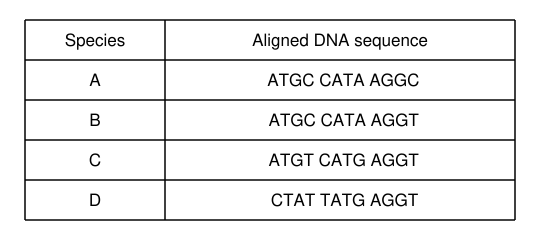
a) Identify the closest pair and state their number of base differences. [2 marks]
b) Calculate the number of differences between A and C. [1 marks]
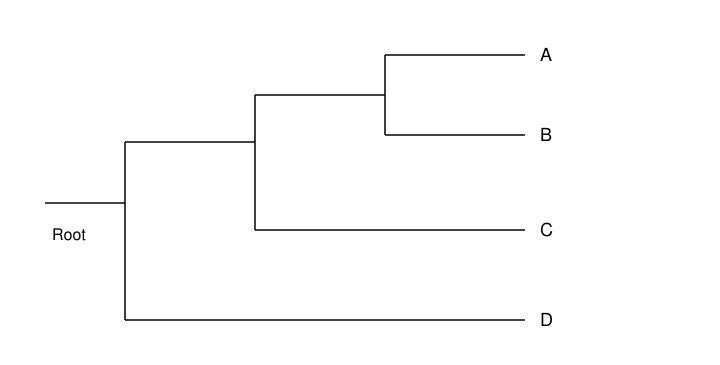
c) Draw a rooted cladogram consistent with the evidence, using D as outgroup. [2 marks]
d) Explain why uncalibrated cladogram branch lengths do not give exact divergence times. [1 marks]
Practice marking scheme
Answer
a) A and B, differing at 1 base. b) 3 bases. c) Rooted topology: (((A,B),C),D). d) No mutation-rate/time calibration is supplied.
Working
A and B differ only at the final position. A and C differ at positions 4, 8 and 12. With D specified as outgroup, A and B form a sister pair joined to C, and D branches outside that group. A cladogram represents branching relationships; exact timing requires appropriate calibration and a rate model rather than measuring the drawing.
Marking criteria
- Identifies A and B as the closest pair. [1 mark]
- Counts one A–B difference. [1 mark]
- Counts three A–C differences. [1 mark]
- Draws A and B as a sister group joined to C. [1 mark]
- Roots with D as outgroup. [1 mark]
- Explains the absence of timing/rate calibration. [1 mark]
Practice question aligned to the current QCAA syllabus; review the worked solution and marking criteria.
View the QCAA syllabusCompare your working with the guide above.