QUESTION 88 (6 marks)
The table describes four evolutionary patterns. Treat the stated lineage relationships as evidence.
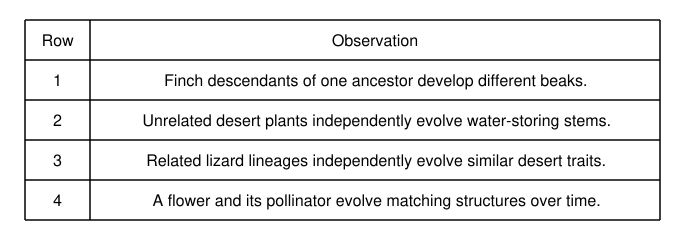
a) Identify the pattern in each row: divergent, convergent, parallel or coevolution. [4 marks]
b) Explain why the reciprocal evolutionary change in row 4 differs from the similarity in row 2. [2 marks]
Practice marking scheme
Answer
a) 1 divergent; 2 convergent; 3 parallel; 4 coevolution. b) Row 4 involves reciprocal selection between interacting species; row 2 involves independent adaptation to similar conditions.
Working
Descendants of one ancestor developing different characteristics represent divergence. Distantly related lineages independently acquiring similar adaptations represent convergence. Related lineages independently evolving similar traits from similar ancestral conditions represent parallel evolution. Reciprocal changes driven by interactions between species represent coevolution: each lineage affects selection on the other.
Marking criteria
- Identifies divergence in row 1. [1 mark]
- Identifies convergence in row 2. [1 mark]
- Identifies parallel evolution in row 3. [1 mark]
- Identifies coevolution in row 4. [1 mark]
- Explains reciprocal selection by the interacting species in row 4. [1 mark]
- Contrasts this with independent responses to similar conditions in row 2. [1 mark]
Practice question aligned to the current QCAA syllabus; review the worked solution and marking criteria.
View the QCAA syllabusCompare your working with the guide above.