QUESTION 86 (7 marks)
A fire kills individuals without regard to genotype. A diploid lizard population is reduced from 200 to 20 individuals. The table records one locus; separate genomic data also show that several rare alleles were lost at other loci.
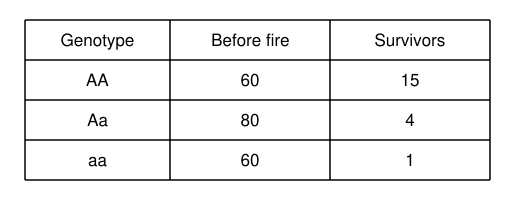
a) Calculate the frequency of A before and after the fire. [3 marks]
b) Identify the process most directly responsible for this change and explain your choice. [2 marks]
c) Explain why loss of genetic diversity can increase extinction risk. [2 marks]
Practice marking scheme
Answer
a) 0.50 before; 0.85 after. b) Genetic drift through a bottleneck, because survival was a chance sample unrelated to genotype. c) Fewer variants can reduce adaptive potential when conditions change.
Working
Before the fire, . Afterwards, . Since mortality is independent of genotype, the surviving alleles form a random small sample: a bottleneck with genetic drift. Loss of variants across the genome can make it less likely that some individuals tolerate future environmental challenges, increasing the chance of population-wide failure.
Marking criteria
- Uses twice the diploid individual count as the allele denominator. [1 mark]
- Calculates initial frequency 0.50. [1 mark]
- Calculates survivor frequency 0.85. [1 mark]
- Identifies genetic drift/bottleneck. [1 mark]
- Links random survival and small sample to chance allele-frequency change. [1 mark]
- Explains reduced available genetic variation/adaptive potential. [1 mark]
- Links this to inability to withstand a future environmental challenge. [1 mark]
Practice question aligned to the current QCAA syllabus; review the worked solution and marking criteria.
View the QCAA syllabusCompare your working with the guide above.