QUESTION 85 (6 marks)
The solid curve is the original distribution of a heritable body-length trait. X and Y are distributions after selection in two independent populations. The same scale is used for all curves.
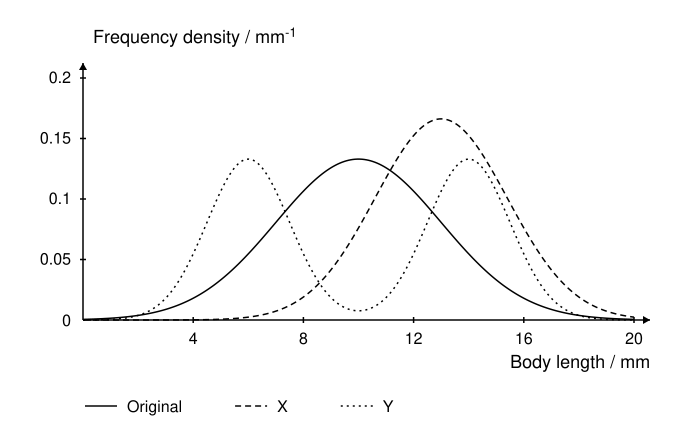
a) Identify the selection type represented by X and Y, supporting each with its shape. [4 marks]
b) Describe how a stabilising-selection result would differ from these two results. [2 marks]
Practice marking scheme
Answer
a) X: directional, with a shift towards larger length; Y: disruptive, with both extremes favoured relative to the middle. b) Stabilising selection favours intermediate phenotypes and narrows the distribution around its middle.
Working
X is displaced towards larger body length, consistent with directional selection favouring one end of the original distribution. Y has peaks on either side of the former centre, consistent with disruptive selection favouring extreme phenotypes. Stabilising selection would reduce the relative frequency of both extremes while preserving the central optimum, usually narrowing the distribution.
Marking criteria
- Identifies X as directional selection. [1 mark]
- Supports X using its shift to larger values. [1 mark]
- Identifies Y as disruptive selection. [1 mark]
- Supports Y using two peaks/extremes and reduced intermediate frequency. [1 mark]
- Describes favouring of intermediate phenotypes in stabilising selection. [1 mark]
- Describes reduction of both extremes/narrowing about the middle. [1 mark]
Practice question aligned to the current QCAA syllabus; review the worked solution and marking criteria.
View the QCAA syllabusCompare your working with the guide above.