QUESTION 11 (4 marks)
Mass extinctions occur when the extinction rate of a taxonomic group exceeds the background extinction rate. Mass extinctions are an important part of macroevolution and are often followed by episodes of evolutionary radiation. The graph shows the extinction rate for marine animals alongside the background
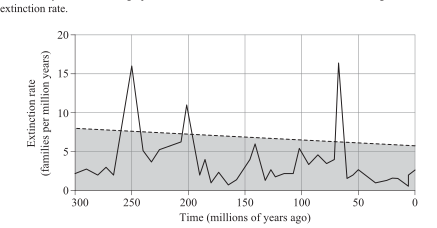
Background extinction rate
Key
Extinction rate for marine animals
a) Identify a trend in the background extinction rate.
[1 mark]
b) Determine how many mass extinctions occurred in the period shown on the graph.
[1 mark]
c) Use the competitive exclusion principle to explain why mass extinctions are often followed by episodes of evolutionary radiation.
[2 marks]
QCAA guide · typeset solution
QCAA sample response and mark allocation
11a) | The background extinction rate has decreased over time. | • identifies that the background extinction rate has decreased [1 mark] |
11b) | 3 mass extinctions | • determines 3 mass extinctions [1 mark] |
11c) | The competitive exclusion principle states that two species with identical niches cannot coexist indefinitely. Mass extinctions create new niches for different species to exploit. | • describes the competitive exclusion principle [1 mark] • explains that mass extinctions create new niches [1 mark] |

Licence: https://creativecommons.org/licenses/by/4.0 | Copyright notice: www.qcaa.qld.edu.au/copyright — lists the full terms and conditions, which specify certain exceptions to the licence. | Attribution: © State of Queensland (QCAA) 2025
QCAA sample response and marking criteria reproduced from the official guide.
Compare your working with the guide above.